Adaptive Versioning for Carrier Integration Middleware: Detecting API Changes Without Breaking Multi-Tenant Operations

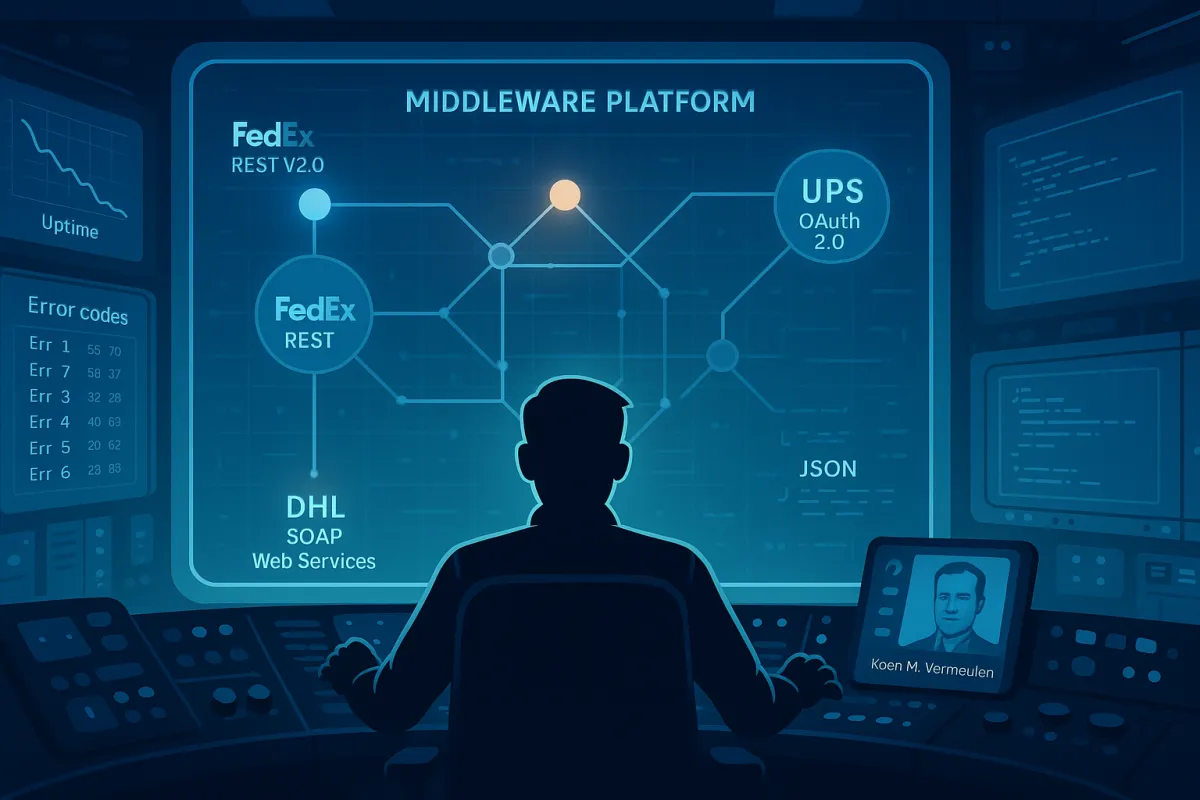
Year 2024 brought a harsh reality check to European shipping middleware: FedEx discontinued support for FedEx Integration (FXI) and began disabling key Web Services WSDLs in August, while UPS moved to OAuth 2.0 authentication with deadlines initially set for May and June, later extended to August and September. For carrier middleware architecture teams managing hundreds of tenant integrations, these weren't just API updates—they were migration nightmares affecting entire multi-tenant operations simultaneously.
The timing couldn't be worse. API downtime surged by 60% between Q1 2024 and Q1 2025, with average uptime dropping from 99.66% to 99.46%. When major carriers force simultaneous API migrations while reliability decreases, traditional version management approaches break down fast.
The Version Detection Challenge in Carrier Integration
Most carrier integration software platforms treat API versioning as a configuration problem—you pick a version, configure endpoints, and hope nothing changes. That approach fails when carriers constantly evolve their APIs. FedEx's SOAP-based Web Services are now in development containment, while authentication models shift from simple access keys to complex OAuth flows.
Here's what traditional monitoring misses: carriers don't announce breaking changes uniformly. FedEx might deprecate a tracking endpoint on Tuesday while DHL adds required fields to address validation on Wednesday. Your middleware needs to detect these changes automatically, not wait for angry tenant support tickets.
Multi-tenant platforms face an amplified problem. When UPS, FedEx, and DHL APIs all change simultaneously, you can't migrate each tenant individually. The entire platform needs adaptive versioning that handles carrier evolution while maintaining tenant isolation.
Multi-Tenant Complexity Amplification
Traditional carrier middleware treats versioning as a per-tenant configuration. Tenant A uses FedEx REST v2.0, Tenant B still runs on SOAP Web Services. This works until carriers force deprecation—then your middleware becomes a coordination nightmare.
The real challenge isn't technical; it's operational. You need systems that can automatically detect when carrier APIs disable legacy endpoints on specific dates and route traffic accordingly. Manual tenant-by-tenant migration doesn't scale when managing hundreds of integrations.
Consider the authentication cascade that occurred during 2024's carrier migrations. When UPS deprecated access key authentication, middleware platforms running thousands of tenant integrations couldn't simply flip a switch. Each tenant needed new credentials, updated configurations, and tested workflows—all while maintaining production traffic.
Architecture Patterns for Version-Aware Middleware
Effective version detection requires middleware that understands carrier-specific patterns. FedEx responds with specific error codes when you hit deprecated endpoints. UPS returns authentication failures that indicate OAuth migration requirements. Your middleware needs to parse these signals automatically.
The key architectural pattern is response fingerprinting. Instead of relying on carrier announcements, your middleware continuously monitors API responses for version indicators: new required fields, authentication changes, deprecated parameters, or error message patterns.
Here's a simple detection layer structure:
- Schema Validation Layer: Compares incoming responses against known schemas, flagging structural changes
- Authentication Monitoring: Detects when carriers reject legacy authentication methods
- Error Pattern Recognition: Maps specific error codes to version migration requirements
- Endpoint Availability Testing: Periodically probes carrier endpoints to detect deprecations
Platforms like EasyPost, nShift, and Cargoson all implement versions of this pattern, though approaches vary significantly. The most successful implementations combine proactive monitoring with automatic fallback routing.
Version Detection Strategies
Semantic versioning with the hierarchical three-number scheme (major.minor.patch) allows API providers to denote different levels of changes. But carriers don't always follow semantic versioning consistently, making detection more complex.
The most reliable approach combines multiple detection methods:
Response Structure Monitoring: Hash the JSON structure of successful API responses. When structures change, your middleware can automatically flag potential version drift before errors occur.
Authentication Method Detection: Monitor authentication rejection patterns. When carriers migrate from API keys to OAuth, rejection messages follow predictable patterns that automated systems can detect.
Endpoint Probe Testing: Run automated availability tests against known carrier endpoints during low-traffic periods. This catches deprecations before they impact production traffic.
The challenge is balancing detection sensitivity with false positive noise. Too aggressive, and you'll flag routine maintenance as version changes. Too conservative, and you'll miss critical deprecations until they cause outages.
Implementation Patterns for Adaptive Middleware
Adaptive versioning middleware requires more than detection—it needs automatic response capabilities. When your system detects that UPS has deprecated access key authentication, it should automatically route new requests through OAuth endpoints while maintaining backward compatibility for existing integrations.
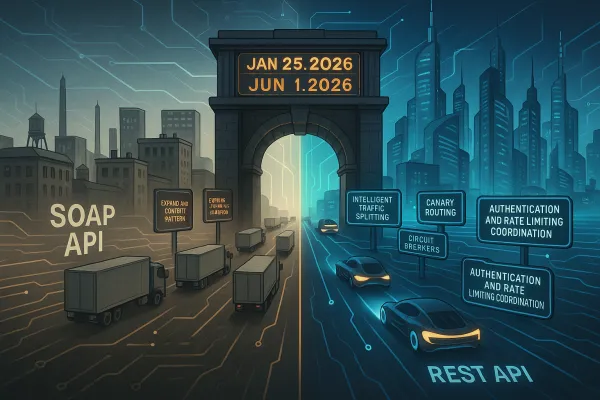
The most effective pattern uses versioned routing layers. Each carrier gets multiple endpoint configurations representing different API versions. Your middleware routes requests through the most appropriate version based on tenant configuration and detected carrier capabilities.
Here's the basic routing logic structure:
function routeCarrierRequest(carrier, tenant, operation) {
const detectedVersions = getCarrierVersionState(carrier);
const tenantPreference = getTenantVersionConfig(tenant, carrier);
// Automatic fallback if preferred version is deprecated
if (detectedVersions.deprecated.includes(tenantPreference)) {
return routeToCompatibleVersion(carrier, operation, detectedVersions.active);
}
return routeToVersion(carrier, operation, tenantPreference);
}
Circuit breakers become crucial here. When latency crosses 500ms thresholds, adaptive algorithms adjust concurrent requests. But in multi-carrier environments, you need per-version circuit breakers to prevent cascading failures when one API version degrades.
Platforms like ShipEngine, ProShip, and Cargoson handle this differently. Some prioritize automatic version promotion—moving tenants to newer API versions when available. Others prefer explicit tenant control, allowing customers to choose migration timing.
Tenant Isolation During Version Transitions
Version changes can't cascade across tenant boundaries. When FedEx deprecates an API version, Tenant A's migration can't impact Tenant B's production shipments. This requires careful isolation patterns throughout your middleware stack.
The most effective approach uses per-tenant version policies. Instead of global carrier configurations, each tenant gets independent version settings that can be updated during maintenance windows. Your middleware maintains separate connection pools, authentication contexts, and retry policies per tenant-carrier-version combination.
Staged rollouts become critical for large-scale operations. You can't migrate 500 tenants from SOAP to REST simultaneously. Instead, implement canary deployments for API versions—migrate 5% of traffic to new versions, monitor error rates and performance, then gradually expand coverage.
Best practices include deprecating versions gracefully with advance notice, maintaining consistency across versioning strategies, using source control for version management, and continuous testing of all API versions.
Monitoring and Observability for Version Changes
Standard observability tools don't understand carrier-specific failure patterns. While Datadog can track response times and error rates, it won't automatically detect that DHL Express API failures spike on Mondays due to system maintenance schedules.
Carrier-aware monitoring requires specialized metrics:
Version Drift Detection: Track the delta between expected and actual API response schemas. High drift scores indicate potential version mismatches before they cause failures.
Authentication Migration Tracking: Monitor the ratio of authentication failures across different credential types. Sudden spikes in access key failures while OAuth succeeds indicates carrier migration progress.
Cross-Carrier Compatibility Scoring: Measure how consistently your middleware handles similar operations across different carriers. This identifies integration patterns that break when carriers change their APIs.
The October 2025 carrier outages revealed that most idempotency mechanisms failed when carriers returned inconsistent errors during version transitions. Your monitoring needs to track idempotency key effectiveness across carrier API versions to detect these patterns early.
Real-time version monitoring becomes crucial during peak seasons. When FedEx, DHL, and UPS APIs all throttle simultaneously during Black Friday volume, you need visibility into which specific API versions are degrading and automatic failover to stable alternatives.
Production Readiness Considerations
Production-ready adaptive versioning requires comprehensive API governance covering naming conventions, versioning standards, backward compatibility rules, and deprecation processes. This goes beyond technical implementation—you need organizational processes that can handle constant carrier evolution.
Your API responses need Deprecation headers with sunset dates, clear migration documentation, and automated compatibility testing across all supported versions. Modern carrier APIs promise fewer major versions in the future, smaller response payloads for better performance, and improved onboarding experiences.
Deployment strategies matter significantly. Blue-green deployments work well for single-version updates, but adaptive middleware needs more sophisticated approaches. Consider per-tenant rollout capabilities where you can deploy new carrier API versions to specific customers while others remain on stable versions.
Feature flags become essential for version-specific functionality. When DHL introduces new required fields, you need the ability to enable these requirements for tenants ready to migrate while maintaining backward compatibility for others.
Enterprise platforms like Oracle Transportation Management, SAP Transportation Management, and Cargoson implement different governance approaches. The key is balancing automation with control—your system should detect and adapt to carrier changes automatically while giving operations teams visibility and override capabilities when needed.
The carrier integration landscape will continue evolving rapidly. While these changes present challenges for businesses relying on legacy integrations, they also offer opportunities to adopt more efficient, secure, and scalable solutions. Your middleware architecture needs to embrace this constant change rather than resist it.