
Concurrent Carrier Migration Architecture: Coordinating USPS, FedEx, and UPS API Transitions Without Breaking Multi-Tenant Shipment Processing

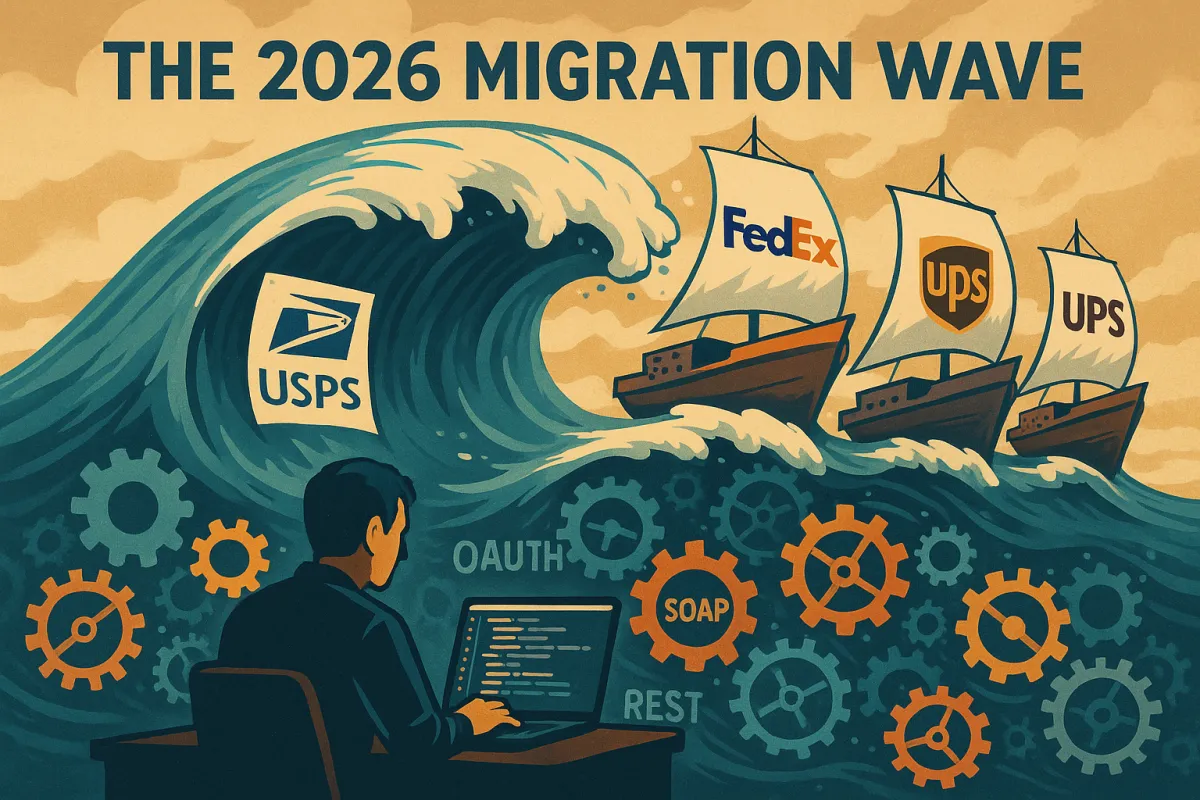
Every integration team thinks they've mastered carrier APIs. USPS Web Tools shut down on January 25, 2026, and FedEx SOAP endpoints retire on June 1, 2026. For the first time in shipping software history, enterprise platforms face three simultaneous carrier migrations with compressed timelines and fundamentally different architectural constraints.
This isn't another gradual migration. By February 3rd, 73% of integration teams reported production authentication failures after UPS's OAuth transition. Now multiply that complexity across USPS and FedEx, add the new reality of aggressive rate limiting, and you have a genuine crisis for teams managing multi-tenant shipment processing at scale.
The numbers tell the story. USPS's legacy API handled roughly 6,000 requests per minute without throttling. The replacement? 60 requests per hour. That's a 6,000x reduction. Meanwhile, WSDL retirement means every integration touching FedEx services requires a complete rebuild. Your existing SOAP calls don't map one-to-one to REST endpoints.
The 2026 Migration Wave: Unprecedented Scale and Timing Compression
The scope of 2026's carrier migrations dwarfs anything integration teams have faced previously. UPS migrated to OAuth 2.0 in August 2025, establishing the pattern that others followed. But where UPS provided a full year for transition, USPS and FedEx compressed their timelines into overlapping windows that create impossible trade-offs.
Compatible Providers must complete upgrades by March 31, 2026, while direct customers have until June 1, 2026 for FedEx. This staggered timeline means enterprise platforms serving both types of customers face dual implementation deadlines. Your Compatible Provider integrations need completion months before your direct customer workflows.
The authentication complexity compounds across carriers. USPS added PKCE mandatory requirements across their APIs in early 2025. Major carriers including USPS and FedEx followed suit, making PKCE mandatory across their APIs. Teams using older OAuth implementations suddenly face authentication failures that monitoring systems classify as temporary network issues.
Enterprise platforms like Cargoson, nShift, EasyPost, and ShipEngine each solved this differently. Some built unified OAuth coordination layers. Others implemented per-carrier abstraction. But the architectural decisions made during UPS's migration now determine how quickly you can adapt to USPS and FedEx changes.
Concurrent Migration Coordination Patterns
Successful concurrent migrations require architecture patterns that treat each carrier transition as a coordinated system change, not isolated integration work. The teams surviving 2026's wave implement landing zone architectures that decouple ingestion from consumption.
The dual-write pattern emerges as the practical solution for production systems. Your application writes to both legacy and modern endpoints simultaneously, comparing results to identify discrepancies before cutover dates. Run parallel systems where your application calls both SOAP and REST endpoints simultaneously, comparing results to identify discrepancies before the June deadline.
But dual-write creates OAuth token management complexity. When UPS, USPS, and FedEx each implement different token refresh patterns, your coordination layer needs carrier-specific logic for concurrent authentication flows. UPS's OAuth implementation can become inconsistent during DynamoDB issues, returning 500 errors while maintaining partial session state. UPS's API returns 500 errors during DynamoDB DNS issues but maintains session state inconsistently.
Leading enterprises standardize on repeatable migration patterns. Enterprise TMS platforms like Cargoson, Manhattan Associates, and SAP TM have already implemented FedEx REST endpoints and are managing dual-API operations for clients during the transition period. The abstraction layer becomes more than technical convenience—it's business continuity insurance.
Phased Rollback Strategies During OAuth Token Failures
Token failure cascades reveal gaps in migration architecture that sandbox testing never exposes. Your retry logic generates new tokens, but the carrier's backend still has references to the old sessions. Scope creep happens when carriers modify permission requirements without notice.
Production-ready rollback requires more than feature flags. You need tenant-specific migration controls, carrier-aware retry logic, and authentication state management that survives partial failures. Data validation failure rates exceeding 5%, critical application functionality being unavailable, or migration downtime surpassing the planned window become rollback triggers that most teams hit within their first month despite passing sandbox testing.
OAuth Token Management Under Migration Load
Concurrent carrier migrations expose OAuth implementation patterns that work in isolation but fail under coordinated load. Each carrier implements token refresh differently, creating authentication coordination challenges that multiply across simultaneous transitions.
OAuth 2.0 Implementation: Version 3 uses OAuth 2.0 for API authentication, replacing legacy authentication methods. This will require the generation and management of new tokens for secure access. But USPS's OAuth differs from FedEx's implementation, which differs from UPS's approach.
The PKCE requirement changes everything. Every FedEx account connected to a shipping platform must complete an MFA flow (typically address validation plus a PIN sent by SMS, phone call, email, or invoice) before the new credentials are issued. Your migration architecture needs account-specific validation workflows that can't be automated.
Token management under concurrent calls reveals architecture gaps. Your test scenarios used a handful of requests. Production generates thousands of concurrent calls, each requiring fresh tokens. The new APIs implement stricter rate limiting, and your token refresh logic starts failing when you hit 50+ requests per second.
The solution requires carrier-aware token coordination. Your OAuth management layer needs different refresh timing for UPS (inconsistent during infrastructure issues) versus USPS (PKCE-enabled) versus FedEx (MFA-gated). Cookie-cutter OAuth libraries break under carrier-specific implementation differences.
Rate Limiting Coordination Architecture
The rate limiting crisis creates architectural constraints that most teams discover too late. At 60 req/hr, a mid-size Shopify store doing 200 orders/day will exceed the rate limit during peak hours. Address validation, rate shopping, label creation, and tracking all share the same 60 req/hr quota.
This isn't a temporary migration constraint—it's permanent infrastructure reality. A batch job that ran in 10 minutes now takes 100 hours. This isn't a migration hiccup — it's a permanent architectural constraint, and your production system needs to account for it.
Enterprise-grade rate limiting coordination requires distributed queue management across multiple carriers with different throttling policies. USPS enforces 60 requests per hour. FedEx implements per-service rate limits. UPS uses error-code-based throttling signals. Carrier APIs don't follow consistent header standards. FedEx uses proprietary headers, UPS implements rate limiting through error codes, and DHL varies by service endpoint. When your system hits FedEx's rate limits, you get proprietary throttling signals.
The coordination architecture needs carrier-specific queue priorities. During peak season, you might prioritize UPS label generation over USPS address validation. But when USPS quotas reset hourly and FedEx quotas reset daily, your priority logic needs temporal awareness that standard rate limiting libraries don't provide.
Burst Handling Across Different Carrier Rate Limits
Orders don't arrive evenly across 24 hours — they cluster between 10 AM and 6 PM, with spikes during lunch and after-work hours. Your rate limiting needs burst smoothing that can handle traffic patterns across carriers with fundamentally different quota structures.
The architecture pattern that works: request queuing with exponential backoff, carrier-specific retry logic, and quota-aware routing. Cargoson, along with competitors like MercuryGate and BluJay, built abstraction layers that handle the OAuth complexity, implement intelligent rate limiting queues, and provide fallback mechanisms when USPS quotas are exceeded.
Multi-Tenant Isolation During Migration Waves
Multi-tenant platforms face the additional complexity of preventing migration failures from cascading across customer boundaries. When Tenant A's FedEx migration fails, Tenant B's shipments need to continue flowing through alternative carriers or rollback configurations.
Tenant-specific migration rollback requires isolation at the authentication, routing, and rate limiting layers. Your OAuth token management needs per-tenant credential storage. Your routing logic needs per-tenant carrier preferences. Your rate limiting needs per-tenant quota allocation that can fail independently.
The isolation extends to migration timing. Enterprise customers might demand immediate FedEx REST access for competitive advantage. SMB customers might prefer delayed migration for operational stability. Multi-carrier shipping platforms have already solved these problems. Cargoson, along with competitors like MercuryGate and BluJay, built abstraction layers that handle the OAuth complexity.
Managed platforms like Cargoson, nShift, and EasyPost provide tenant isolation by design. Custom-built integrations require explicit architecture for tenant boundary enforcement during migration waves. The complexity multiplies when tenants use different carrier account types (Compatible Provider versus direct customer for FedEx).
Production Readiness Testing for Concurrent Migrations
Sandbox testing provides false confidence for concurrent carrier migrations. Your webhook endpoints pass every sandbox test. Rate requests return perfect responses. Authentication flows work flawlessly. Then you deploy to production and discover what 72% of implementations face: reliability issues within their first month despite passing sandbox testing.
The disconnect runs deeper than most teams realize. Sandbox environments use different OAuth flows, relaxed rate limits, and synthetic data that doesn't trigger the edge cases that break production systems. The most common error shippers hit isn't technical. It's a typo on a street address or a stale company name that doesn't validate.
Production validation requires testing OAuth flows under concurrent load, validating rate limit consumption across multiple carriers, and rehearsing rollback procedures with real customer traffic. The authentication testing needs to simulate carrier infrastructure issues that only appear in production.
Load testing with concurrent OAuth flows reveals token refresh race conditions. When your application refreshes UPS, USPS, and FedEx tokens simultaneously under peak traffic, the authentication coordination becomes a bottleneck that sandbox testing never exposes. Your concurrent migration architecture needs testing patterns that stress authentication systems under realistic load.
Operational Monitoring and Alerting Architecture
Standard monitoring tools like Datadog and New Relic miss the authentication patterns that break carrier integrations. They track HTTP status codes and response times, but they can't detect when OAuth token refresh logic fails under concurrent load or when carrier-specific rate limits create authentication cascades. Generic monitoring misses carrier-specific failure patterns.
Carrier-aware monitoring requires understanding that if UPS typically takes 200ms for rate requests but suddenly needs 800ms, that's actionable. But if FedEx jumps from 150ms to 250ms during their known maintenance window, that might be expected behavior requiring different escalation.
The alerting architecture needs carrier-specific thresholds, authentication failure pattern recognition, and migration progress visibility across tenant boundaries. Your monitoring needs to distinguish between temporary throttling and actual service failures, because response strategies differ completely.
Migration health tracking requires metrics beyond HTTP status codes. OAuth token refresh success rates, carrier-specific rate limit consumption, and tenant-specific migration progress become business-critical observability requirements during concurrent transitions.
Managed services from Cargoson, nShift, and EasyPost provide migration monitoring by design—they've already built the observability patterns for tracking multi-carrier authentication health and migration progress. Teams building custom solutions need explicit architecture for carrier-aware monitoring during the 2026 migration wave.
The choice facing integration teams isn't technical perfection versus operational shortcuts. The companies that survive 2026's migration crisis won't be the ones with perfect technical execution. They'll be the ones who recognized that carrier integrations are infrastructure, not features, and invested accordingly. Your choice: spend the next six months debugging OAuth flows and rate limiting edge cases, or let someone else handle that while you focus on growing your business.
The 2026 carrier migration wave represents a permanent shift toward managed complexity. The migration deadlines are immovable. The rate limiting constraints are permanent. Your choice is whether to build the resilience your enterprise needs, or let carrier API changes control your shipping operations. Choose accordingly.