Legacy Carrier Integration Migration Patterns: Eliminating Technical Debt During the 2026 SOAP to REST Transition Without Breaking Shipment Processing


Three major carriers are pulling the plug on legacy SOAP APIs in 2026, and USPS retired its Web Tools API platform on January 25, 2026 and service disruptions are underway. FedEx's remaining SOAP-based endpoints will be fully retired in June 2026, after which integrations must use FedEx's REST APIs to access rates, labels, tracking, and future service updates. Your legacy carrier integration middleware isn't just outdated—it's becoming non-functional.
The problem runs deeper than a simple API swap. Most carrier middleware built between 2010-2020 accumulated years of technical debt around SOAP message handling, XML parsing logic, and WS-Security authentication flows. Shippers using older protocols like XML or SOAP for their API integrations will have to make a conversion to something that's RESTful compatible. This isn't just about changing endpoints—it's about eliminating the architectural mistakes that made these systems brittle in the first place.
The 2026 Legacy Carrier Migration Crisis
The scale of this migration is unprecedented. USPS Web Tools APIs powered thousands of shipping integrations for years, and for IT and engineering teams, this means rebuilding authentication, endpoints, error handling, and operational workflows—likely under tight timelines. Unlike previous carrier API updates that offered extended transition periods, these are hard cutoffs with immediate business impact.
Here's what makes 2026 different: carriers are moving from XML-based SOAP protocols to JSON REST APIs while simultaneously upgrading from simple API keys to OAuth 2.0 authentication and updated encryption protocols. API Version 3 introduces changes to endpoint structures and request/response formats, requiring review of updated API documentation to identify necessary modifications in implementations.
The business impact isn't theoretical. Companies running mission-critical shipping operations can't afford weeks of downtime for a "big bang" rewrite. Yet many legacy systems were built with so much embedded business logic in SOAP message handlers that extracting and modernizing that logic becomes a months-long project. Sound familiar?
Migration Architecture Patterns for Zero-Downtime Transitions
The solution lies in proven migration patterns that allow both old and new systems to coexist during the transition. Rather than rewriting everything at once, these patterns let you gradually modernize while maintaining business continuity.
Strangler Fig Pattern Implementation for Carrier Endpoints
The Strangler Fig pattern provides a controlled and phased approach to modernization, where a façade routes requests either to the legacy application or to the new services. For carrier integration middleware, this means introducing an API gateway that can handle both SOAP and REST protocols while you migrate functionality piece by piece.
Here's how it works in practice: A routing layer directs incoming requests either to the existing legacy system or to newly developed modern components, allowing both systems to coexist during the transition. Start with a low-risk carrier function like address validation, build the REST equivalent, then route new requests to the modern service while legacy requests continue flowing to the SOAP handler.
The key is choosing the right migration sequence. Teams should choose a low-risk, high-value module to modernise – such as a self-contained feature that is frequently used and easy to decouple. For FedEx integration, rate shopping APIs are often good candidates because they're stateless and have clear input/output boundaries.
Event-Driven Bridge Architecture
For complex label generation workflows where multiple systems need coordination, event-driven patterns solve the dual-write problem inherent in migrating from SOAP to REST. The transactional outbox pattern uses a transaction to update both the state and an outbox table at the same time, where the outbox is a log of events that need to be emitted, then a separate process scans the outbox and emits any pending events.
This pattern prevents the scenario where your system successfully creates a label via SOAP but fails to emit the corresponding event via REST, causing downstream systems to get out of sync. When a new order comes in through a REST interface, the order is persisted in the database and an OrderCreated event is sent to a Kafka topic, eliminating the consistency issues that plague dual-write architectures.
Multi-Tenant Migration Coordination Patterns
If you're operating multi-tenant carrier middleware, tenant-by-tenant rollout becomes essential for managing risk. The challenge is maintaining tenant isolation while gradually migrating customers from SOAP to REST endpoints. Feature flags provide the control mechanism you need.
Implementation looks like this: each tenant gets a configuration flag determining whether their carrier calls use legacy SOAP or modern REST. You can start with your smallest tenants as pilot customers, validate the new integration works correctly, then gradually expand to larger customers. API gateways can direct traffic to legacy or new services based on path, version, headers, or feature flags.
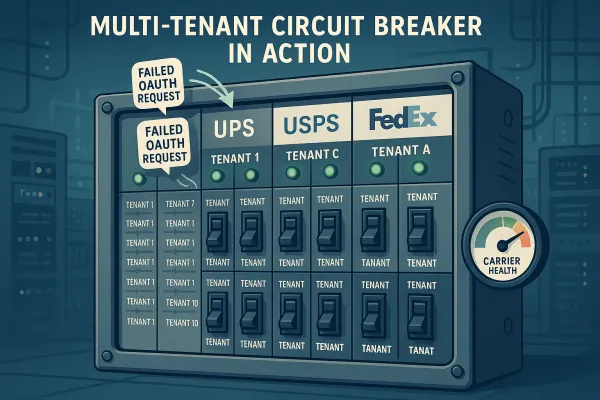
Circuit breakers become crucial during this transition phase. A service client should invoke a remote service via a proxy that functions like a circuit breaker, and when consecutive failures cross a threshold, the circuit breaker trips, and for the duration of a timeout period all attempts to invoke the remote service will fail immediately. This prevents cascade failures when you're running both SOAP and REST integrations in parallel.
Technical Debt Elimination Strategies
The real value of this migration isn't just protocol modernization—it's the opportunity to eliminate years of technical debt. Most legacy SOAP handlers contain embedded business logic that should live in separate services. Rate calculation logic, address validation rules, and label formatting operations often get tangled up with XML parsing and SOAP envelope handling.
Schema mapping requires careful attention to prevent data loss during XML to JSON conversion. USPS tracking responses, for example, include nested XML structures that don't translate directly to flat JSON objects. You need explicit mapping logic that preserves all the data relationships your business logic depends on.
Authentication migration presents another challenge. Both carriers are moving to a RESTful API using a more advanced security model like OAuth 2.0 instead of single access key authentication. This means rebuilding not just the authentication flow, but also the credential management, token refresh logic, and error handling around expired tokens.
Error handling standardization becomes an opportunity to improve observability. Legacy SOAP faults often get swallowed or poorly logged. Modern REST APIs with structured error responses let you implement proper retry logic, circuit breakers, and detailed telemetry. Companies like Cargoson, nShift, EasyPost, and ShipEngine have all had to solve these same technical debt challenges during their own modernization efforts.
Testing and Validation Frameworks
Parallel execution testing becomes your safety net. During the migration period, you can run both SOAP and REST calls for the same operation, then compare the results to validate your new implementation. This works particularly well for rate shopping, where you can compare pricing responses between old and new systems without affecting customer transactions.
Contract testing ensures API compatibility as you migrate. Rather than discovering integration problems in production, contract tests validate that your new REST implementation satisfies the same business contracts as your legacy SOAP handlers. This is especially important for address validation and tracking endpoints where subtle changes in response format can break downstream systems.
Load testing becomes critical because REST and SOAP performance characteristics differ significantly. REST APIs typically handle higher throughput due to reduced message overhead, but your migration might reveal bottlenecks in JSON processing or HTTP connection pooling that didn't exist with SOAP. Test with realistic traffic patterns, especially during peak shipping seasons.
Production Cutover Orchestration
Blue-green deployment provides the safest migration path for carrier endpoint switches. Maintain two complete environments: blue running your legacy SOAP integration, green running the new REST implementation. You can validate the green environment with live traffic shadows, then switch DNS or load balancer routing when you're confident in the new system.
Rollback procedures need careful planning because carrier integrations often have state implications. A failed label generation in REST can't be simply retried in SOAP if label numbers or tracking IDs were already allocated. Your rollback plan needs to account for these stateful operations and have procedures for handling partially completed transactions.
Post-Migration Architecture Optimization
Once migration completes, you'll discover performance improvements from REST adoption. JSON parsing is typically faster than XML processing, OAuth 2.0 tokens reduce authentication overhead compared to WS-Security signing, and HTTP/2 connection multiplexing improves request throughput. Measure these improvements to quantify the business value of your migration effort.
Observability enhancement becomes possible with modern APIs. Version 3 introduces enhanced tracking capabilities with more detailed tracking data and granular updates, plus advanced rate calculations with enhanced pricing logic for real-time shipping cost estimation. You can implement distributed tracing across carrier calls, detailed SLA monitoring, and better error correlation than was practical with SOAP-based systems.
Future-proofing considerations include designing your new architecture to handle the next wave of carrier API changes. Carriers are already experimenting with GraphQL endpoints, webhook-based event delivery, and real-time rate negotiation APIs. The modular, service-oriented architecture you build during this migration will make future changes less disruptive.
The 2026 migration deadline is immovable, but with proper architectural patterns, you can eliminate technical debt while maintaining business continuity. Start with the Strangler Fig pattern for gradual migration, implement event-driven patterns for consistency, and use the opportunity to build more resilient, observable systems. Your future self will thank you for doing this migration properly instead of rushing to meet the deadline.