Multi-Agent Carrier Integration: How Agentic AI Protocols Are Reshaping Middleware Architecture for Autonomous Shipping Operations

Enterprise applications are moving fast. By the end of 2026, 40% of them will embed task-specific AI agents, up from less than 5% in 2025. For carrier integration middleware, this shift represents more than just another technology trend. Industry analysts project the agentic AI market will surge from $7.8 billion today to over $52 billion by 2030, and logistics platforms are already building the infrastructure that will handle this transformation.
Multi-agent orchestration protocols are becoming the invisible backbone enabling carrier integration platforms to coordinate specialized shipping agents autonomously. No more monolithic middleware struggling to handle rate shopping, compliance checking, and exception management in a single system. Instead, we're seeing specialized agents that can negotiate with each other, delegate tasks, and recover from failures without human intervention.
Essential Protocols Enabling Agent-to-Agent Carrier Coordination
MCP (Model Context Protocol) is an open-source standard for connecting AI applications to external systems. Think of MCP like a USB-C port for AI applications — it provides a standardized way to connect AI applications to external systems. In March 2025, OpenAI officially adopted the MCP, after having integrated the standard across its products. The protocol's rapid uptake by OpenAI, Google DeepMind, and toolmakers like Zed and Sourcegraph suggests growing consensus around its utility.
For carrier integration, MCP solves a specific problem: connecting agents to carrier APIs, databases, and compliance systems. MCP is not an agent framework, but a standardized integration layer for agents accessing tools. Your rate shopping agent uses MCP to connect to FedEx, UPS, and DHL APIs. Your compliance agent uses it to access customs databases and documentation systems.
Google's Agent2Agent (A2A) protocol, launched with support from more than 50 technology partners like Atlassian, Box, Cohere, Intuit, MongoDB, PayPal, Salesforce, SAP, ServiceNow, and UKG, tackles the coordination between agents themselves. The Agent2Agent (A2A) protocol is an open communication protocol for artificial intelligence (AI) agents designed for multi-agent systems, allowing interoperability between AI agents from varied providers or those built using different AI agent frameworks.
On July 31, 2025, A2A version 0.3 was released—adding gRPC support, signed security cards, and extended Python SDK support; the protocol now counts over 150 supported organizations. The momentum matters because a 2025 global AI survey reveals that 29% of enterprises are already running agentic AI in production, with another 44% planning to join them within a year.
Architecture Patterns for Multi-Agent Carrier Middleware
Sequential orchestration represents the simplest approach. Your rate shopping agent queries carriers, passes results to a carrier selection agent, which then hands off to a label generation agent. Each step waits for the previous to complete. This works well for standard shipments but creates bottlenecks during peak periods.
Concurrent orchestration runs agents in parallel. Multiple rate shopping agents query different carrier groups simultaneously while a compliance agent validates addresses and customs requirements. Results converge at a decision point where the orchestration layer selects optimal routing. AI-powered carrier selection compares not just prices and estimated delivery times, but also evaluates historical carrier performance, service reliability, and customer preferences.
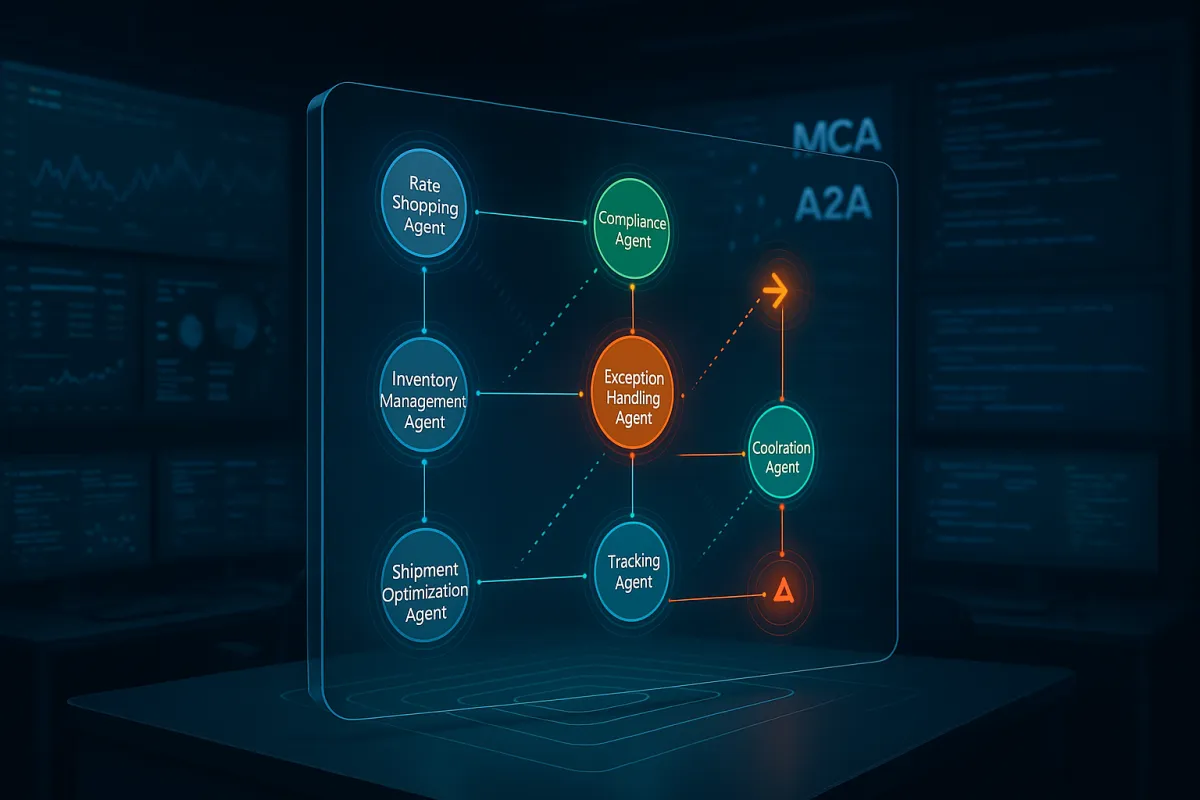
Collaborative orchestration pushes intelligence into the agents themselves. Agents negotiate directly using A2A protocols. Your capacity agent might signal upcoming constraints to the rate shopping agent, which adjusts its queries to favor carriers with available capacity. Exception handling agents can interrupt standard workflows when they detect delivery risks.
Specialized Agent Types in Modern Carrier Integration
Rate shopping agents coordinate across carrier APIs to find optimal pricing and delivery combinations. These aren't simple API wrappers — they understand carrier-specific quirks, rate rules, and service mapping. A sophisticated rate shopping agent learns that DHL Express consistently outperforms their published transit times on EU-US routes, while UPS Ground tends to exceed estimates during Q4.
Compliance agents handle the complexity of international shipping regulations, customs documentation, and restricted goods validation. When a shipment encounters a customs delay, the agent automatically prepares updated documents, notifies the customer, and proposes an alternative delivery route. They maintain connections to customs databases, restricted party screening systems, and trade compliance platforms through MCP interfaces.
Exception handling agents monitor shipments in transit and coordinate recovery when things go wrong. They detect delays, capacity constraints, and delivery failures, then negotiate with other agents to implement recovery plans. Some platforms like ClickPost have developed specialized AI NDR agents that rescue failed deliveries and schedule reattempts with carriers.
Customer communication agents handle proactive notifications and updates throughout the shipping lifecycle. These agents understand that an enterprise customer shipping automotive parts has different communication needs than an e-commerce business shipping consumer electronics. They adapt messaging frequency, channels, and detail levels based on customer profiles and shipment characteristics.
The key insight is that each agent type requires different protocol implementations. Rate shopping agents need high-frequency, low-latency communication for real-time quotes. Compliance agents work with larger data exchanges and longer processing times. Exception handling requires interrupt-capable protocols that can break into ongoing workflows.
Production Implementation Challenges and Solutions
State management across agent boundaries creates the most complex issues. When a rate shopping agent passes a quote to a carrier selection agent, what happens if the carrier selection agent needs additional rate information? Traditional approaches store state in a central database, but this creates bottlenecks and single points of failure.
Modern solutions use event sourcing patterns where each agent publishes state changes to event streams. Other agents subscribe to relevant events and maintain their own projections of shared state. This approach works well for A2A implementations where agents might be running on different systems or even different companies' infrastructure.
Error recovery becomes more nuanced in multi-agent systems. When a carrier API fails during rate shopping, a monolithic system might retry the same call or fail the entire request. An agent-based system can delegate the failure to a specialized retry agent that understands carrier-specific failure patterns and implements appropriate backoff strategies.
Observability presents unique challenges when agents coordinate across organizational boundaries. You need to trace request flows that span multiple agent systems while respecting privacy boundaries. Companies using advanced AI logistics platforms report significant operational improvements, including a 40% reduction in breach costs and a 50% decrease in time to analyze data.
Protocol Standardization Impact on Vendor Lock-in
Instead of maintaining separate connectors for each data source, developers can now build against a standard protocol. As the ecosystem matures, AI systems will maintain context as they move between different tools and datasets, replacing today's fragmented integrations with a more sustainable architecture.
The standardization trend reduces custom integration costs significantly. Before MCP and A2A, connecting a new carrier required building custom adapters, authentication flows, and data transformation layers. With standardized protocols, carriers can expose MCP-compatible endpoints that any compliant agent can consume immediately.
Vendor-agnostic interoperability enables "plug-and-play" carrier connections where businesses can switch between carrier integration platforms without rebuilding their entire stack. Platforms like nShift integrate with over 1,000 carrier services and 450+ platforms, powering seamless delivery across 190 countries. Similar capabilities are becoming available through protocol standards rather than proprietary integrations.
Major platforms including Cargoson, EasyPost, nShift, and ShipEngine are all moving toward protocol-based architectures. This creates competitive pressure to support open standards rather than maintaining proprietary approaches that create customer lock-in.
2026 Implementation Roadmap and Preparation
Start with single-agent implementations using MCP to connect existing systems. Choose a specific use case like rate shopping or tracking updates and build a pilot agent that can connect to carrier APIs through standardized interfaces. This approach validates your infrastructure and team capabilities without the complexity of multi-agent coordination.
Q2-Q3 2026 should focus on multi-agent orchestration testing in sandbox environments. Build specialized agents for different shipping functions and implement A2A communication between them. As embedded agents become standard, organizations will require governance layers, observability, and lifecycle management, making orchestration platforms mission-critical.
Q4 2026 and beyond represents the production deployment phase with full agent coordination. By this time, protocol maturity and vendor support should be sufficient for enterprise deployments. Gartner predicts that 15% of day-to-day work decisions will be made autonomously through agentic AI by 2028, while 33% of enterprise software applications will include agentic AI by the same timeframe.
Budget planning should account for infrastructure changes, training, and potential integration costs. 88% of surveyed senior executives plan to increase their AI budgets within 12 months due to agentic AI. However, the ROI comes from reduced integration maintenance, faster carrier onboarding, and improved exception handling that reduces manual intervention costs.
Integration with existing TMS and ERP systems requires careful planning. Many enterprise systems weren't designed for agent-based architectures, so you'll need to build interface layers that translate between traditional system calls and agent protocols. The good news is that MCP provides standardized approaches for these integrations.
The transition from traditional carrier integration middleware to multi-agent orchestration isn't just about adopting new protocols. It's about restructuring how shipping operations handle complexity, scale, and coordination. Organizations that begin building agent-based capabilities now will have significant advantages as protocol standards mature and vendor ecosystems expand.