Multi-Gateway Coordination for Carrier Integration: Architecture Patterns That Scale Across Distributed Teams

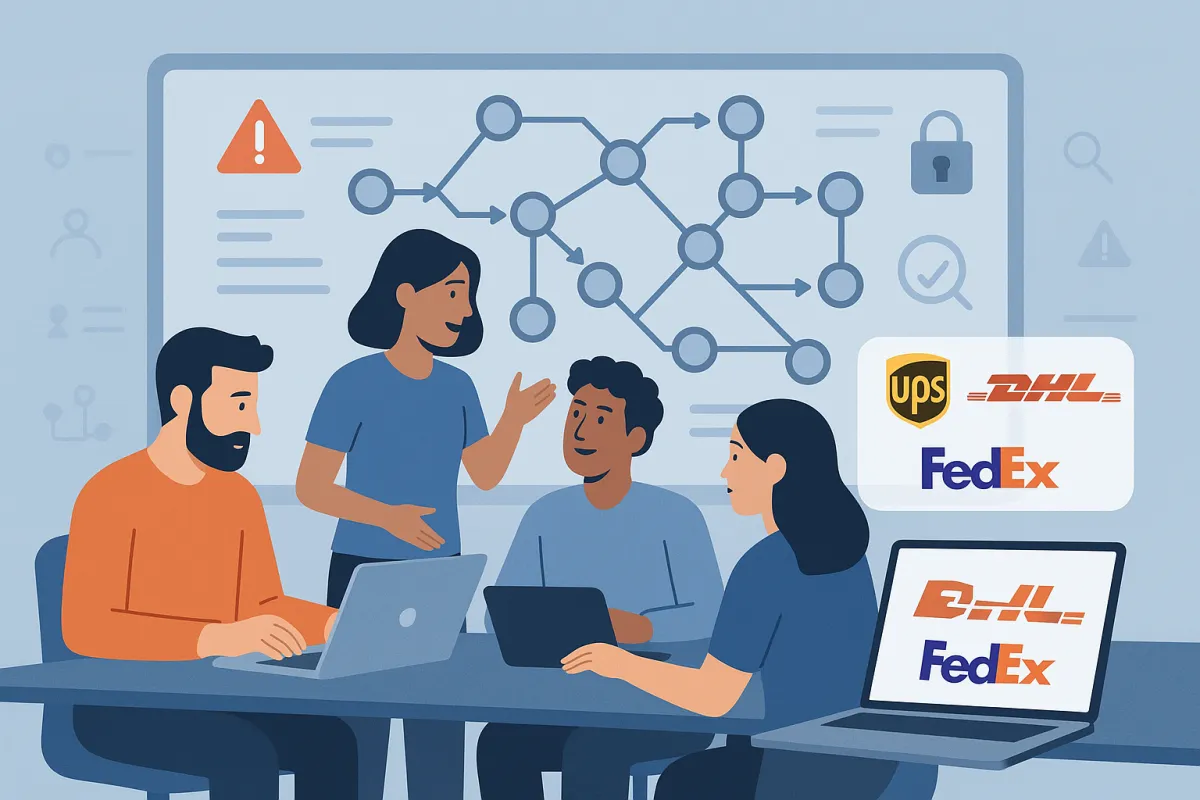
You know the statistics. By 2028, more than 75% of corporate organizations will use two or more API gateways driven by mergers, regional expansions, and team autonomy requirements. But here's what most architects miss: carrier integration platforms face unique coordination challenges that traditional multi-gateway patterns barely address.
When UPS APIs are handled by your North American gateway cluster while DHL routes through your European instance, and FedEx gets distributed across both for compliance reasons, you need more than basic federation. Tenant isolation failures in carrier middleware can impact API request authorization logic across multiple gateways, creating blast radius scenarios that single-gateway deployments never encounter.
The Multi-Gateway Reality in Carrier Integration
While bringing flexibility and scalability, this new dynamic also poses challenges in visibility, security, and governance. For carrier integration platforms, these challenges multiply. Consider a typical enterprise shipper's architecture: their legacy TMS runs carrier APIs through an on-premises Kong gateway, their new microservices route through AWS API Gateway, and their recently acquired European subsidiary operates Traefik in their Kubernetes clusters.
Sound familiar? Multigateway enterprise architectures are becoming increasingly popular, with API development frameworks providing native support for distributed and federated networks of gateways. The numbers support this trend: financial services, telecoms, and travel sectors faced 40,000 API incidents in the first half of 2025, with attacks projected to hit 80,000+ by year end.
Why do carrier integration platforms naturally evolve toward multi-gateway deployments? Three primary drivers:
- Regulatory compliance: European data residency requires local gateway instances, while GDPR processing demands different routing rules than CCPA requirements.
- Merger and acquisition complexity: M&A drives organizations to adopt different gateways to meet functional requirements across domains, especially when acquired companies bring established carrier relationships.
- Team autonomy demands: Development teams prefer familiar tools—your Ruby team wants Kong, while your .NET team standardized on Azure API Management years ago.
The failure patterns when coordination is missing become obvious quickly. Rate shopping requests hang when the primary gateway can't reach carriers handled by secondary instances. Webhook deliveries duplicate across gateways, causing downstream processing chaos. Circuit breaker states don't propagate, allowing failed carriers to overload the entire system.
Coordination Challenges Unique to Carrier Middleware
Traditional API gateway federation focuses on request routing and policy enforcement. Carrier integration adds layers of complexity that generic patterns don't address well.
Tenant Routing Consistency Across Gateways
Multi-tenancy explodes into complexity when you need real isolation, routing, and observability at scale, with the gateway enforcing multi-tenant request routing. When Tenant A's FedEx shipments route through Gateway 1 while their UPS requests hit Gateway 2, maintaining consistent routing rules becomes non-trivial.
If cached data might vary between tenants, ensure that you include the tenant identifier in the cache key to reduce the chance of accidentally referring to another tenant's value. But in multi-gateway scenarios, cache invalidation becomes a distributed systems problem. When Tenant B's rate changes propagate to Gateway 1's cache, how do you ensure Gateway 2's cache stays consistent?
Rate Shopping Orchestration Challenges
Rate shopping—where you query multiple carriers simultaneously to find optimal pricing—becomes complex when carriers are distributed across gateways. Your rate shopping engine needs to coordinate requests across gateway boundaries while maintaining timeout consistency and error handling.
The coordination patterns that work:
- Scatter-gather with coordination service: A central coordinator dispatches rate requests to appropriate gateways, aggregates responses, and handles partial failures.
- Event-driven rate collection: Gateways publish rate responses to a shared event stream, with the rate shopping service consuming and correlating responses.
- Federated query routing: Different gateways can be configured to meet specific needs while centrally managing configurations and monitoring.
Webhook Delivery Coordination and Deduplication
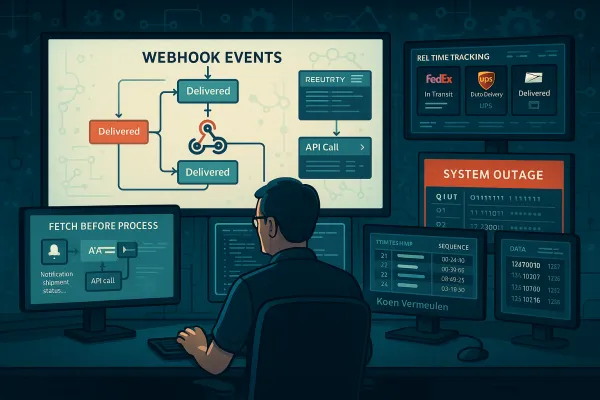
Carrier webhooks fail at rates that would bankrupt a traditional SaaS platform, with substantial business costs including lost sales and operational disruption. Multi-gateway deployments compound this problem. When FedEx delivers a tracking update webhook to Gateway 1, but your webhook processing service expects all carrier events through Gateway 2, you need coordination mechanisms that traditional API management doesn't provide.
Deduplication becomes particularly tricky. Each gateway might process the same webhook event, requiring distributed deduplication keys and coordination to prevent duplicate processing downstream.
Data Consistency Patterns for Multi-Gateway Coordination
Standard approaches to distributed data consistency apply to multi-gateway carrier integration, but with domain-specific considerations.
Event Sourcing for Cross-Gateway State Management
Event sourcing works well for tracking carrier integration state across gateways. When Gateway 1 processes a label creation request, it publishes a "LabelCreated" event. Gateway 2 can subscribe to this event stream to maintain its own view of shipment states without direct database coupling.
The event store becomes your source of truth for cross-gateway state. Rate limit exhaustion, circuit breaker state changes, and tenant configuration updates all flow through the event stream, ensuring eventually consistent views across gateway instances.
Saga Pattern for Distributed Carrier Transactions
The SAGA pattern enables coordination and execution of multiple operations across services, ensuring global transaction consistency with automatic compensation steps. For carrier operations spanning multiple gateways, sagas handle the coordination complexity.
Consider a shipment creation that requires label generation via Gateway 1 (FedEx API) and customs documentation via Gateway 2 (DHL API). A saga coordinates this workflow, handling compensation if either step fails—canceling the FedEx label if DHL customs filing fails.
CQRS for Read/Write Separation
Command Query Responsibility Segregation (CQRS) helps manage the complexity of multi-gateway carrier integration. Write operations—label creation, rate requests, shipment modifications—go through appropriate gateways based on carrier routing rules. Read operations—shipment status, tracking history, rate comparisons—query consolidated read models that aggregate data from multiple gateways.
Reference Architecture: Federated Gateway Controller
Here's a reference architecture that addresses the coordination challenges in multi-gateway carrier integration platforms:
┌─────────────────────────────────────────────────────────────┐
│ Federated Gateway Controller │
│ ┌─────────────────┐ ┌─────────────────┐ ┌──────────────┐ │
│ │ Routing │ │ Configuration │ │ Health │ │
│ │ Registry │ │ Sync │ │ Monitor │ │
│ └─────────────────┘ └─────────────────┘ └──────────────┘ │
└─────────────────────────┬───────────────────────────────────┘
│
┌────────────────┼────────────────┐
│ │ │
┌────▼─────┐ ┌─────▼──────┐ ┌────▼─────┐
│Gateway 1 │ │ Gateway 2 │ │Gateway N │
│(FedEx, │ │(DHL, UPS) │ │(Regional)│
│ Carrier A)│ │ │ │ │
└──┬───────┘ └──┬─────────┘ └──┬───────┘
│ │ │
┌──▼───────┐ ┌───▼──────────┐ ┌──▼───────┐
│Carrier │ │ Carrier │ │Regional │
│Services │ │ Services │ │Carriers │
└──────────┘ └──────────────┘ └──────────┘
The Federated Gateway Controller sits above individual gateway instances, providing:
- Routing Registry: Maintains mappings of which carriers route through which gateways, with tenant-specific overrides
- Configuration Sync: Propagates policy changes, rate limits, and circuit breaker states across gateway instances
- Health Monitor: Tracks gateway health and triggers failover routing when gateways become unavailable
This pattern works well with existing solutions. Cargoson's universal API approach could integrate with this controller model, alongside platforms like nShift, EasyPost, or ShipEngine for comprehensive carrier coverage.
Routing Decision Trees
The controller uses decision trees to determine routing:
- Tenant preference: Does this tenant have carrier-specific gateway requirements?
- Carrier availability: Which gateways currently have healthy connections to the target carrier?
- Geographic constraints: Do data residency requirements force specific gateway routing?
- Load balancing: Which gateway has current capacity for this request type?
Fallback patterns ensure resilience. If the primary gateway for UPS requests is unavailable, the controller routes to secondary gateways with UPS connectivity, updating routing tables to reflect the temporary change.
Configuration Synchronization Patterns
The federated model requires coordination between distributed teams and management over their data planes, with a combination of enterprise features and network segregation. Two approaches work well:
- Push model: The controller pushes configuration changes to gateway instances, using event streams or direct API calls
- Pull model: Gateway instances poll the controller for configuration updates on scheduled intervals
Conflict resolution becomes important when configurations diverge. Version control for distributed gateway configs helps track changes and rollback problematic updates. Each gateway maintains a configuration version number, and the controller can detect drift and remediate.
Implementation Strategies and Trade-offs
The implementation approach depends heavily on whether you're building greenfield or migrating existing systems.
Greenfield deployments can start with federated patterns from day one. Design your carrier integration platform with multi-gateway coordination as a core requirement. Choose gateway technologies that support federation—Kong's federated model, AWS API Gateway's stage management, or Azure API Management's multi-region deployment.
Brownfield migrations require more careful planning. Gateway federation offers a smooth transition path by allowing organizations to manage legacy gateways alongside newer ones, enabling gradual migration and replacement. Start by implementing the federated controller as a proxy layer above existing gateways, then gradually migrate routing logic and configuration management.
Performance implications matter. The coordination overhead adds latency to every request that crosses gateway boundaries. For carrier integration, where rate shopping might query 5-10 carriers simultaneously, the overhead compounds. Measure carefully and optimize for your specific traffic patterns.
When to consolidate vs federate: Consolidation makes sense when your carrier portfolio is stable and your team structure supports centralized management. Federation pays off when you have diverse carrier requirements, complex compliance needs, or distributed development teams that benefit from technology autonomy.
Observability and Debugging Multi-Gateway Systems
Implement detailed performance monitoring on a per-tenant basis using APM tools with multi-tenancy support and provide performance dashboards for transparency. Multi-gateway carrier integration requires enhanced observability beyond single-gateway deployments.
Distributed tracing across gateway boundaries becomes essential. When a rate shopping request spans three gateways to query different carriers, your tracing system needs to correlate the entire request flow. Use correlation IDs that propagate through all gateway instances and downstream carrier API calls.
SLO definitions need to account for multi-gateway complexity. Your "rate shopping response time" SLO might need to accommodate the reality that requests cross multiple gateway boundaries. Define SLOs for both individual gateway performance and end-to-end request flows.
Troubleshooting Common Coordination Failures
Split-brain scenarios happen when gateway instances lose connectivity to the coordination controller but remain healthy for carrier API calls. Implement leader election or consensus mechanisms to prevent conflicting routing decisions.
Configuration drift detection helps catch gradual divergence between gateway instances. Regular configuration audits and automated drift detection prevent subtle inconsistencies that manifest as intermittent failures.
Cross-gateway circuit breaker cascades require careful circuit breaker design. When FedEx APIs fail, the circuit breaker on Gateway 1 should trigger, but it shouldn't cascade to Gateway 2's healthy UPS connections. Design circuit breakers with carrier-specific and gateway-specific scoping.
The coordination complexity is real, but the benefits justify the investment. Multi-gateway coordination enables the carrier integration architecture that modern enterprises need: resilient, compliant, and capable of scaling with business requirements. Start with the patterns that match your current complexity, then evolve toward full federation as your platform matures.
Next week, we'll dive deeper into the specific technical patterns for webhook coordination across multiple gateway instances—including the deduplication algorithms that prevent carrier event storms from overwhelming downstream processing systems.