Multi-Step Carrier Workflow Orchestration: How Arazzo 1.0 Specification Solves the European Logistics Reliability Crisis

Multi-step carrier workflow orchestration represents one of the most complex reliability challenges in European logistics today. Between Q1 2024 and Q1 2025, average API uptime fell from 99.66% to 99.46%, resulting in 60% more downtime year-over-year. While these percentage changes might seem modest, they translate to actual business disruption hitting European shippers during peak seasons when every millisecond counts.
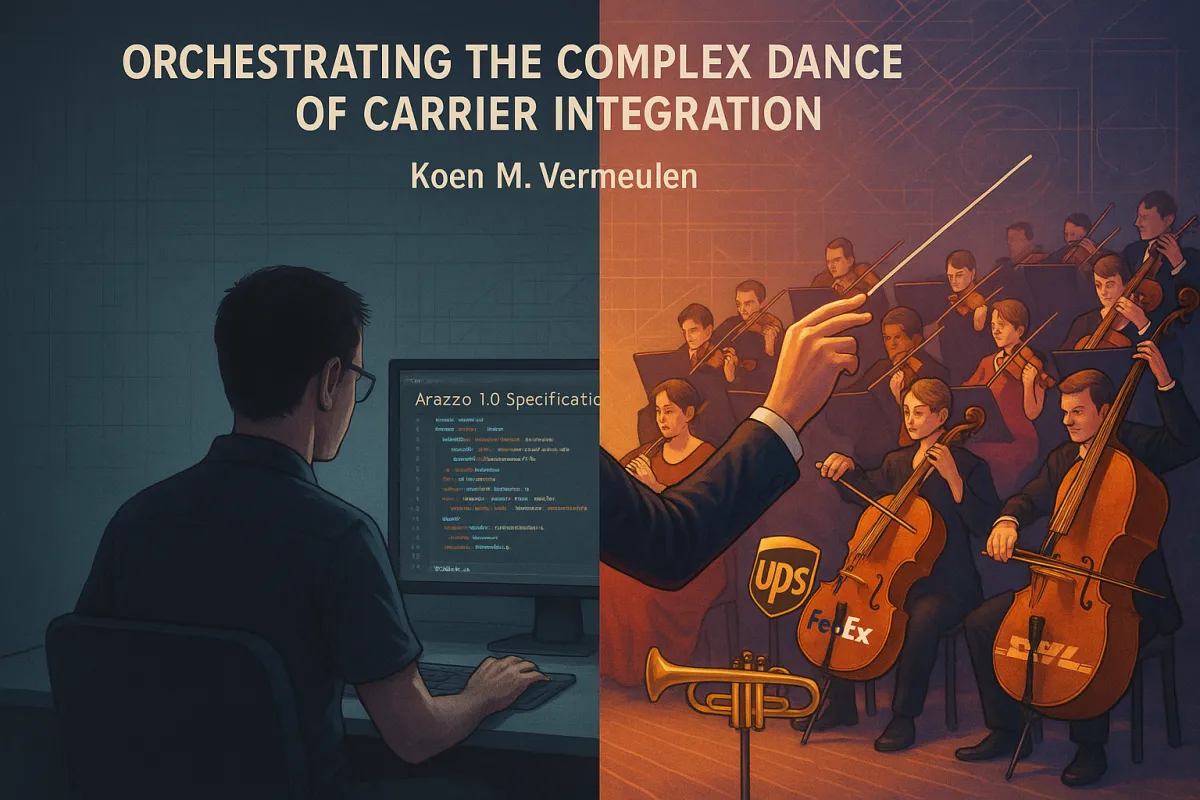
The problem isn't just connectivity—it's the intricate dance between multiple carrier APIs that must work in concert. A typical rate shopping request might query UPS, then book with FedEx based on the result, followed by DHL tracking integration and final delivery confirmation webhooks. When one step fails or delivers partial results, the entire workflow collapses into retry storms and duplicate shipments.
The Hidden Crisis in Carrier Integration Workflows
European carrier integrations are experiencing failure patterns that should concern any integration engineer managing real-time logistics operations. Our test data showed that conveyor-integrated shipping systems experience complete workflow failures when latency exceeds 750ms for more than 30 seconds. This threshold represents a critical breaking point where automated warehouse systems begin generating cascading failures.
The statistics reveal deeper systemic issues. For carrier integration teams, this translates to something more troubling: duplicate shipments and inventory mismanagement when retry logic fails. Enterprise TMS teams managing carrier integrations for UPS, FedEx, DHL and other major carriers face a stark reality: over 90% of organizations report downtime costs exceeding $300,000 per hour. These aren't just numbers in a monitoring dashboard—they represent actual business impact affecting everything from customer satisfaction to operational cashflow.
Peak season amplifies these problems exponentially. When FedEx, DHL, and UPS APIs all throttle simultaneously during Black Friday volume, those theoretical improvements disappear fast. Traditional monitoring tools report individual API health, but they miss the workflow-level failures that occur when carrier services are technically functional yet collectively unreliable.
Why Traditional Request-Response Patterns Fail for Logistics
Carrier operations aren't individual API calls—they're state machines spanning multiple providers over time. A merchant needs to compare DHL and UPS rates, book the optimal service, generate labels, trigger tracking events, handle delivery exceptions, and process returns. Each step depends on outputs from previous steps, creating temporal coupling that breaks traditional stateless API patterns.
Consider a rate shopping workflow that queries three carriers simultaneously. If one carrier responds immediately, another times out, and the third returns a rate but fails during booking, what should happen? Most integration platforms handle this through ad-hoc retry logic and manual exception handling, creating brittle solutions that fail under load.
The fundamental mismatch lies in treating multi-step business processes as collections of independent API calls. Operations within APIs are rarely used in isolation or any other context. A true REST API should be stateless in it technical implementation but that doesn't eliminate the presence of business context.
Understanding Arazzo 1.0: Beyond OpenAPI's Single-Endpoint Limitations
Today, we're excited to kick off 2025 on a strong note by announcing the release of Arazzo Specification version 1.0.1! The timing couldn't be more relevant for carrier integration engineers wrestling with multi-step workflow reliability challenges. Arazzo provides a description for a group of APIs and their relationships. The primary focus of this release is to introduce support for AsyncAPI, enabling workflows to span APIs that leverage both HTTP and event-driven protocols. This exciting development will expand Arazzo's capabilities, making it a more versatile and comprehensive solution for modern API ecosystems.
Unlike OpenAPI, which excels at describing individual endpoints, The Arazzo Specification introduces a solution for adding a layer of abstraction to define a series of API calls. It also describes their dependencies, which can be linked together to produce a particular outcome. This addresses the fundamental gap in carrier integration architecture where business workflows span multiple carrier APIs with complex dependencies.
The specification provides machine-readable workflow definitions that enable tooling to understand and orchestrate entire business processes. The Arazzo Specification defines a standard, programming language-agnostic mechanism to express sequences of calls and articulate the dependencies between them to achieve a particular outcome, or set of outcomes, when dealing with API descriptions (such as OpenAPI descriptions). The Arazzo Specification can articulate these workflows in a deterministic human-readable and machine-readable manner.
For carrier integration teams, this means moving from ad-hoc workflow coordination to declarative workflow definitions that can be version-controlled, tested, and deployed consistently across environments.
Mapping Carrier Operations to Arazzo Workflows
Translating logistics business processes into Arazzo workflow definitions requires understanding both the technical dependencies and business semantics. A multi-carrier rate shopping workflow might define dependencies where DHL rate requests can run parallel to FedEx queries, but booking must wait for rate comparison completion, and tracking setup depends on successful booking confirmation.
Using sourceDescriptions enables developers to focus on specifying the workflow and not on the details of the API itself. This separation allows carrier integration platforms to reference existing OpenAPI specifications for UPS, FedEx, and DHL while focusing Arazzo definitions on the business logic that orchestrates between them.
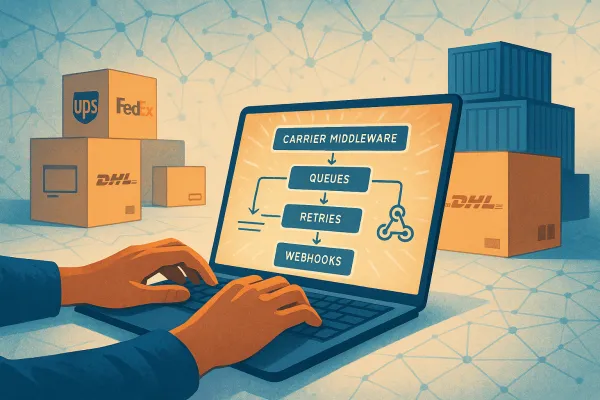
The workflow definitions become executable specifications that platforms like Cargoson, nShift, EasyPost, and ShipEngine can use to ensure consistent behaviour across different deployment environments. Instead of embedding workflow logic in application code, the logic becomes declaratively defined and portable between systems.
Architecture Patterns for Fault-Tolerant Workflow Execution
Implementing Arazzo-defined workflows requires integrating proven resilience patterns with modern workflow orchestration capabilities. It extracts the coordination from the filter implementations into a state machine that orchestrates the sequence of events. Visual workflows allow you to change the sequence of execution without modifying code, reducing the amount of coupling between collaborating components.
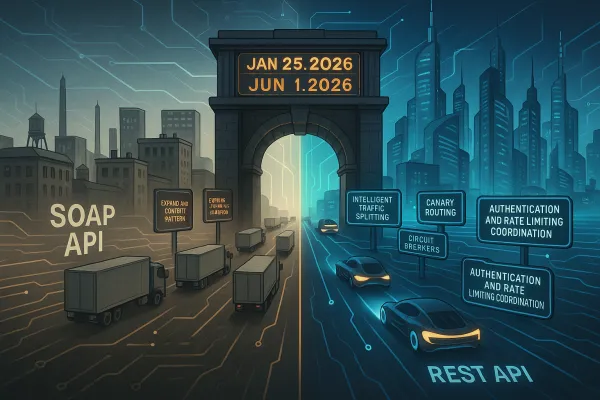
Circuit breaker patterns become workflow-aware when integrated with Arazzo definitions. Instead of protecting individual carrier API calls, circuit breakers can understand workflow context—protecting entire rate shopping sequences or booking workflows when downstream carriers exhibit instability. This provides more granular control than traditional API-level circuit breaking.
State persistence requires careful consideration in multi-step carrier workflows. This is where the saga pattern and AWS Step Functions can help. The saga pattern provides compensation mechanisms for failed workflow steps, ensuring that partial bookings or rate locks can be properly cleaned up when subsequent steps fail.
Retry strategies become more sophisticated when orchestrating multiple carrier interactions. Rather than simple exponential backoff per API call, Arazzo-aware retry logic can understand workflow dependencies and adjust retry behaviour based on business context. If DHL booking fails, the system might retry with UPS booking while maintaining tracking integration consistency.
Orchestration vs Choreography in Carrier Workflows
Carrier integration architectures must choose between centralized orchestration and distributed choreography patterns. Process orchestration coordinates the various moving parts (or endpoints) of a business process, and sometimes even ties multiple processes together. A process orchestrator centralizes and controls the process flow; Gartner points out that "because the flow control is centralized, it's relatively simple to monitor, optimize and modify the orchestrated process in one place."
Centralized orchestration works well for rate shopping and booking workflows where business logic requires coordination between multiple carriers with clear dependencies. The orchestrator understands carrier capabilities, applies business rules for carrier selection, and manages the booking sequence.
Event-driven choreography suits tracking and delivery notification workflows where carriers publish status updates that trigger downstream actions. Garter says that process choreography "is suitable for simple transaction flows that involve a small number of participants when process monitoring service is not implemented." However, tracking workflows often involve multiple participants—carriers, TMS systems, customer notification services, and exception handling systems.
Platforms like MercuryGate and Transporeon typically implement hybrid approaches, using centralized orchestration for booking workflows while employing choreography for tracking events. Cargoson's approach emphasizes workflow-aware orchestration that can adapt between patterns based on operational context and carrier capabilities.
Implementation Strategy: Migrating from Ad-Hoc to Arazzo-Defined Workflows
Migrating existing carrier integration platforms to Arazzo-based workflows requires a gradual approach that maintains backward compatibility while introducing workflow standardisation. The migration typically starts with documenting existing webhook chains and API sequences as Arazzo workflow definitions.
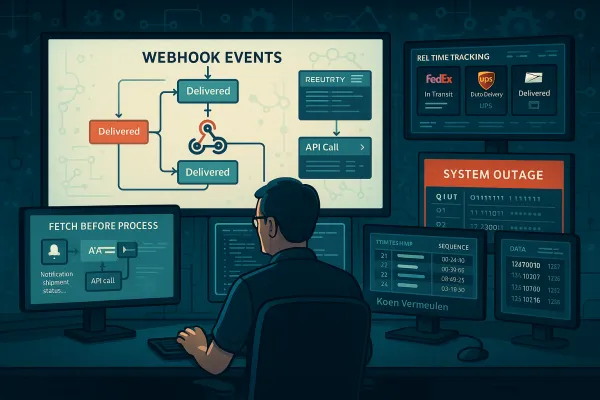
Legacy webhook chains often contain implicit dependencies and error handling logic embedded in application code. Converting these to declarative Arazzo workflows exposes hidden complexity and enables systematic optimization. What appears as a simple webhook chain might reveal circular dependencies or race conditions when formally documented.
Testing strategies must account for workflow-level behaviour rather than just individual API responses. Integration tests need to verify not just that carrier APIs respond correctly, but that the complete workflow produces expected business outcomes under various failure scenarios.
Backward compatibility requirements mean existing webhook endpoints and API integration patterns must continue working while new Arazzo-based workflows are introduced. This typically involves implementing adapter layers that can translate between legacy integration patterns and new workflow-aware orchestration engines.
Observability and Monitoring for Multi-Step Workflows
Workflow-aware observability requires rethinking traditional API monitoring approaches. Instead of tracking individual request/response cycles, monitoring must understand workflow context and business semantics. When you design your observability and testing strategies, consider the following recommendations: Instrument all agent operations and handoffs. Troubleshooting distributed systems is a computer science challenge, and orchestrated AI agents are no exception. Track performance and resource usage metrics for each agent so that you can establish a baseline, find bottlenecks, and optimize.
Distributed tracing becomes essential for understanding workflow execution across multiple carrier APIs. OpenTelemetry spans should include workflow step identifiers, enabling correlation between business process steps and underlying technical operations. This allows teams to identify whether rate shopping delays stem from specific carrier API latency or workflow orchestration overhead.
Step-level SLOs provide more meaningful business metrics than traditional API uptime percentages. Instead of measuring DHL API availability, teams can track "rate shopping workflow completion within 2 seconds" or "booking workflow success rate above 99.5%".
Business process monitoring requires understanding carrier-specific behaviour patterns. Some carriers consistently respond slowly on Monday mornings due to maintenance windows, while others throttle aggressively during peak seasons. Workflow-aware monitoring can account for these patterns when establishing baselines and alerting thresholds.
Performance Optimization for Multi-Carrier Workflow Execution
Minimizing latency in complex carrier workflows requires understanding both technical constraints and business requirements. Benefits: Can be faster due to potential parallelism, potentially uses fewer LLM tokens by minimizing iterative observation steps, more resilient to cascading failures if one step fails early. Benefits: Highly efficient by maximizing parallel execution and minimizing LLM calls during the execution phase. While this example refers to AI workflows, the principles apply directly to carrier integration optimization.
Parallel rate shopping represents the most obvious optimization opportunity. Rather than sequential carrier queries, Arazzo workflows can define parallel execution paths for independent rate requests. The workflow orchestrator can fan out requests to multiple carriers simultaneously, then wait for responses before proceeding to booking selection logic.
Prefetching carrier capabilities reduces workflow initialization overhead. Many carrier workflows require preliminary calls to check service availability or validate postal codes before proceeding with rate requests. These validation calls can be cached and refreshed asynchronously, reducing the critical path latency for rate shopping workflows.
Connection pooling becomes more sophisticated when managing multiple carrier connections within workflow context. Instead of managing connection pools per carrier API, workflow-aware connection management can optimize based on workflow patterns—keeping DHL connections warm when UPS bookings typically trigger DHL tracking setup.
Performance comparisons across platforms reveal significant differences in workflow execution efficiency. Blue Yonder's approach emphasizes caching and predictive prefetching, while Manhattan Active focuses on connection optimization. Cargoson's architecture combines workflow-aware caching with intelligent carrier selection algorithms that account for both cost and performance characteristics.
Scaling Workflow Execution for High-Volume Logistics Operations
Horizontal scaling patterns for Arazzo-based workflow engines must account for both state management and workflow distribution complexity. Utilize serverless architecture and built-in parallel processing to handle growing workloads efficiently, enabling cost-effective scaling from a few to millions of workflow executions.
State partitioning strategies need to balance workflow consistency with scalability requirements. Rate shopping workflows can be partitioned by geographic region or carrier, while booking workflows might require stronger consistency guarantees that limit partitioning options.
Load balancing becomes workflow-aware when orchestrating carrier integrations. Traditional round-robin or least-connections algorithms don't account for carrier-specific latency patterns or rate limiting behaviour. Workflow-aware load balancing can route rate shopping requests to instances with warm carrier connections while directing booking workflows to instances with established carrier authentication sessions.
Resource management requires understanding workflow resource consumption patterns. Booking workflows typically consume more memory due to state persistence requirements, while rate shopping workflows are more CPU-intensive due to parallel carrier communication. Capacity planning must account for these different resource profiles when scaling workflow execution infrastructure.
The emergence of Arazzo 1.0 as a standard provides European logistics operations with a foundation for building reliable, observable, and maintainable carrier integration workflows. Rather than continuing to rely on ad-hoc webhook chains and brittle retry logic, platforms can adopt declarative workflow definitions that improve both development velocity and operational reliability.
For carrier integration engineers, the path forward involves evaluating current workflow complexity, identifying orchestration vs choreography requirements, and gradually migrating to Arazzo-based workflow definitions. The specification's machine-readable format enables tooling automation that can dramatically reduce the operational overhead of managing multi-carrier integrations at European scale.