Multi-Tenant Circuit Breaker Patterns for Carrier Integration: Preventing OAuth Authentication Cascades During the 2026 API Migration Wave

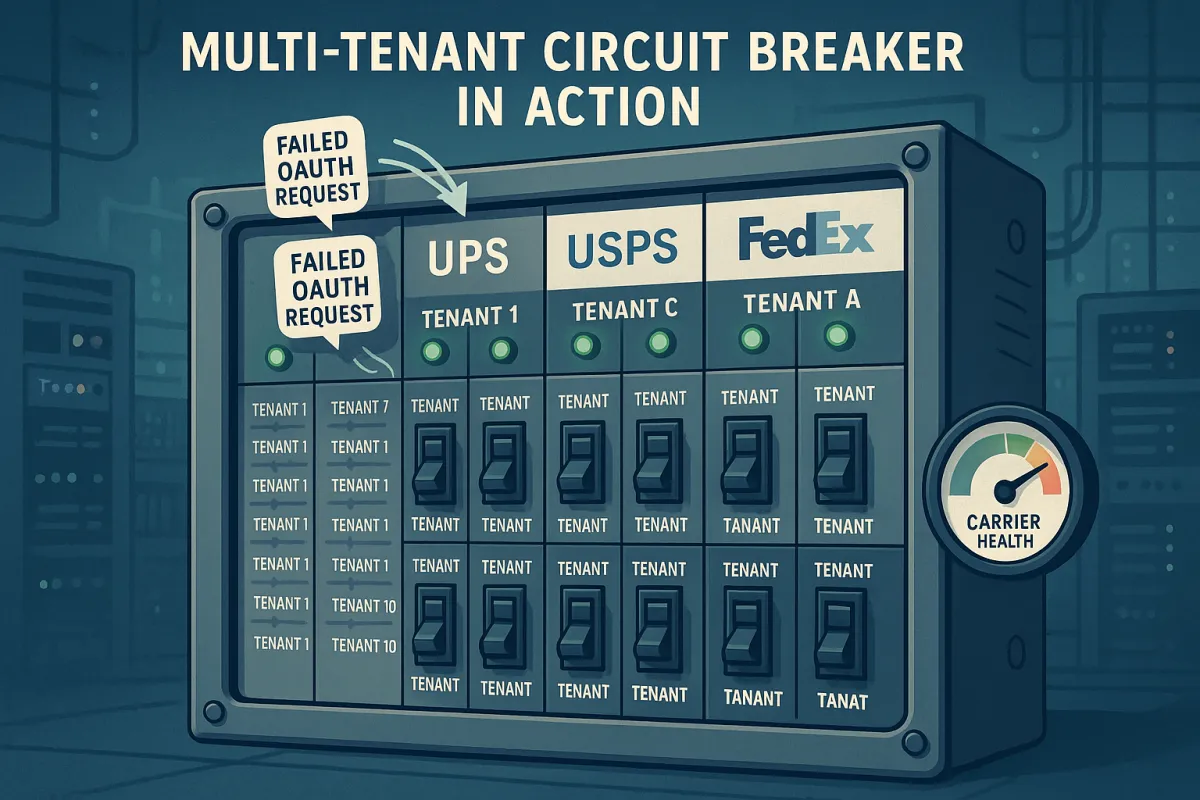
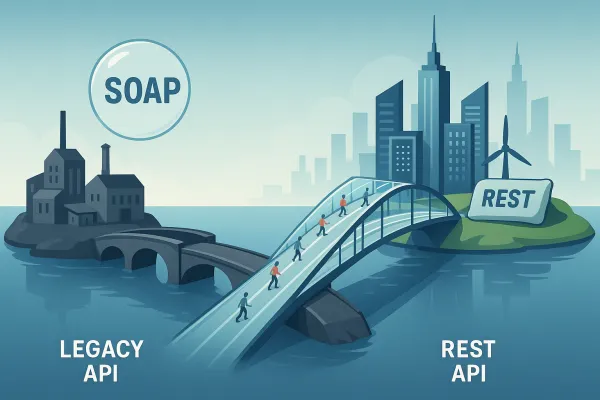
Major carriers including UPS, USPS, and FedEx are completing their API modernization wave in 2026, with remaining SOAP-based endpoints fully retired by June 2026 and all integrations required to use REST APIs. But here's what nobody talks about: both carriers are moving to OAuth 2.0 authentication instead of single access key authentication, creating entirely new failure modes for multi-tenant carrier integration middleware.
When FedEx's OAuth service goes down, traditional circuit breaker patterns fail catastrophically in multi-tenant environments. Authentication systems amplify isolation failures because they operate before authorization, meaning one carrier's authentication hiccup shouldn't cascade across all tenants using that carrier. Yet most carrier integration middleware treats circuit breakers as a single-tenant concern.
You need tenant-aware circuit breaker patterns that prevent authentication failures from creating blast radius problems across your customer base.
The Cascade Problem with Traditional Circuit Breakers
Standard circuit breaker implementations track failure rates globally per service endpoint. When FedEx's OAuth token service hits its failure threshold, the circuit opens for everyone. Every tenant trying to create shipping labels through FedEx gets blocked, even if the failure started with just one tenant's authentication issues.
Carriers are responding to fraud and security issues by tightening how shipping data and accounts are accessed, with modern authentication standards giving them more control over access and making abnormal behavior easier to detect. This heightened security creates new edge cases where individual tenant configurations can fail independently.
Consider this scenario: Tenant A has misconfigured OAuth credentials for UPS. Their requests start failing authentication. A traditional circuit breaker sees these failures, opens the circuit, and suddenly Tenant B's perfectly configured UPS integration stops working because they share the same circuit breaker state.
Multi-tenant carrier integration middleware needs circuit breakers that understand tenant boundaries. A system is only "multi-tenant" if tenants are isolated in practice, and that isolation exists on a spectrum. Circuit breakers are part of that isolation boundary.
Tenant-Aware Circuit Breaker Architecture
Effective tenant-aware circuit breakers maintain separate state per tenant-carrier combination while sharing failure signal intelligence across tenants where appropriate. You need three layers of circuit breaker state:
Tenant-Carrier Circuit State: Each tenant maintains independent circuit breaker state for each carrier. When Tenant A's UPS OAuth fails, only Tenant A's UPS circuit opens. Tenant B's UPS integration continues normally.
Carrier Health Signaling: Aggregate failure signals across tenants to detect carrier-wide outages. If 80% of tenants experience UPS authentication failures within a 5-minute window, that's likely a carrier issue, not tenant-specific configuration problems.
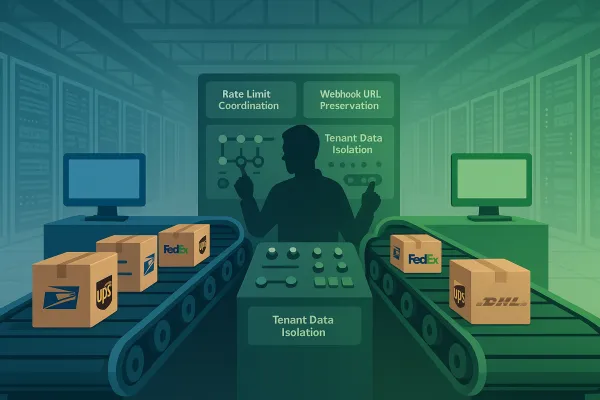
Tenant Isolation Boundaries: Effective tenant isolation requires consistent enforcement across application logic, identity providers, token issuance, data access, and infrastructure. Circuit breaker state must respect these same boundaries.
Implementation requires careful state management. Store circuit breaker state with composite keys: `{tenant_id}:{carrier}:{service_type}`. This prevents state pollution between tenants while enabling carrier-specific circuit behavior.
OAuth Authentication Failure Isolation
USPS API Version 3 uses OAuth 2.0 for API authentication, replacing legacy authentication methods and requiring the generation and management of new tokens for secure access. OAuth introduces specific failure modes that tenant-aware circuit breakers must handle differently:
Token Refresh Failures: When OAuth tokens expire, refresh operations can fail due to tenant-specific credential issues or carrier-side rate limiting. Circuit breakers should distinguish between "tenant has bad credentials" and "carrier OAuth service is down".
Credential Rotation Edge Cases: During OAuth credential rotation, temporary authentication failures are expected for specific tenants. The circuit breaker shouldn't penalize other tenants for these planned transitions.
Rate Limiting Isolation: Carriers may apply OAuth rate limiting per client credentials. Heavy usage by one tenant shouldn't trigger circuit breaker trips for other tenants using the same carrier but different credentials.
Implementation Patterns for Multi-Tenant Circuit Breakers
Here's a practical approach to tenant-aware circuit breaking that handles OAuth authentication failures correctly:
Context Propagation: Every carrier API request must carry tenant context through the entire request pipeline. The key insight is treating tenant context as a security boundary that's as important as user authentication, with every service call, database query, and cache access carrying tenant context and validating it appropriately.
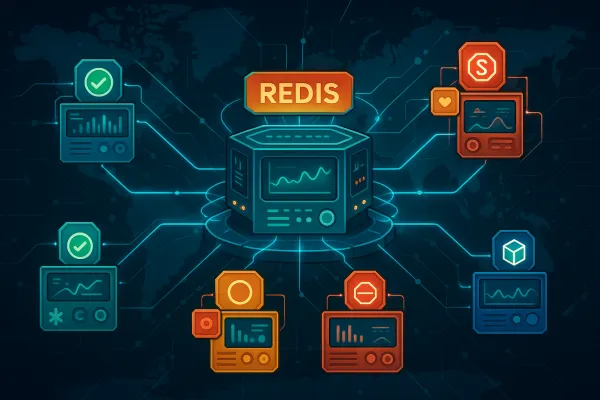
State Storage Strategy: Use Redis or similar for circuit breaker state with hierarchical keys: `circuit:{tenant_id}:{carrier}:{operation}`. This enables per-tenant circuit control while supporting cross-tenant carrier health monitoring.
Failure Classification: Not all failures should trigger circuit breakers equally. OAuth authentication failures due to expired credentials are different from network timeouts. Classify failures by cause and adjust circuit breaker sensitivity accordingly.
Configuration Isolation: Tenant isolation is enforced by design through tenant IDs in data, tenant context in runtime, and tenant-aware auth. Circuit breaker thresholds, timeouts, and retry policies should be configurable per tenant to handle different SLA requirements.
Advanced implementations can use machine learning to detect anomalous failure patterns. If Tenant A typically has a 0.1% UPS failure rate but suddenly jumps to 50%, that's probably a tenant configuration issue, not a reason to trip circuits for other tenants.
Surviving the 2026 Migration Wave
The USPS Web Tools API platform officially shuts down on Sunday, January 25, 2026, with all Web Tools integrations stopping function after this date. Similar transitions are happening across major carriers, creating a perfect storm of authentication edge cases.
During these migrations, tenant-aware circuit breakers become survival tools. Some tenants will migrate early, others will wait until the last minute, and some will have migration issues. Your circuit breaker implementation needs to handle this gracefully without creating outages for successfully migrated tenants.
Migration-Aware Circuit Logic: Implement circuit breaker rules that account for expected migration turbulence. During known carrier maintenance windows, increase failure thresholds and extend timeout windows.
Graceful Degradation by Tenant: When a tenant's circuit trips during migration, provide clear feedback about which specific carrier integration is affected rather than failing silently or blocking all shipping operations.
Rollback Safety: Carriers will continue updating pricing logic, delivery data, security requirements, and services even after migrations are complete. Design circuit breaker state to handle rollbacks and configuration changes without losing tenant isolation guarantees.
Multi-tenant middleware platforms like Cargoson, alongside solutions such as nShift, EasyPost, and ShipEngine, are all adapting their circuit breaker strategies to handle 2026's authentication complexity while maintaining tenant isolation.
Production Considerations and SLO Impact
Tenant-aware circuit breakers add operational complexity, but they're essential for maintaining SLOs during authentication failures. Here are the key production considerations:
Monitoring Granularity: Track circuit breaker metrics per tenant-carrier combination. Alert on patterns: if multiple tenants experience authentication failures with the same carrier simultaneously, investigate carrier-side issues.
Cost Implications: Storing circuit breaker state per tenant scales linearly with tenant count. For 1,000 tenants supporting 10 carriers each, you're managing 10,000 independent circuit breaker state machines. Budget accordingly.
SLO Boundary Management: Noisy-neighbor risk becomes expensive as you scale, requiring smaller blast radiuses to maintain service quality. Tenant-aware circuit breakers directly support SLO isolation by preventing one tenant's authentication problems from affecting others.
Operational Complexity: Teams need dashboards that show circuit breaker state across the tenant-carrier matrix. Without proper tooling, debugging authentication failures becomes exponentially harder in multi-tenant environments.
The math works in your favor: a few additional milliseconds of tenant context lookup during circuit breaker evaluation prevents potentially hours of downtime when authentication failures cascade across tenants.
Circuit breaker tuning requires different strategies per carrier. UPS might need aggressive failure detection due to their OAuth implementation quirks, while USPS might need longer timeout windows during peak shipping seasons. Tenant-aware circuit breakers let you optimize these settings without creating one-size-fits-none compromises.
As the 2026 carrier API migration wave continues, the middleware that survives will be the platforms that solved tenant isolation at the infrastructure level, not just the application level. Circuit breakers are infrastructure.