Surviving Carrier API Breakage: Architecture Patterns That Withstand Major Service Transitions


When FedEx Freight becomes a standalone public company by June 2026, enterprise TMS platforms face integration challenges that go far beyond updating API endpoints. FedEx Freight currently handles roughly 90,000 shipments per day and generates nearly $9 billion in annual revenue, making this corporate separation one of the most significant carrier API transitions in recent shipping history.
The numbers tell a sobering story about carrier API reliability. Between Q1 2024 and Q1 2025, average API uptime fell from 99.66% to 99.46%, resulting in 60% more downtime year-over-year. Meanwhile, 72% of implementations face reliability issues within their first month of production deployment. These statistics aren't theoretical - they represent production reality hitting European shippers trying to maintain reliable multi-carrier integrations during peak season.
How Corporate Restructures Break Carrier Integrations
Corporate spinoffs like FedEx Freight's separation create unique integration challenges that standard monitoring can't catch. FedEx plans to spend $600 million enhancing IT infrastructure and systems ahead of the spinoff, but that investment focuses on internal systems, not the API contracts your TMS platform depends on.
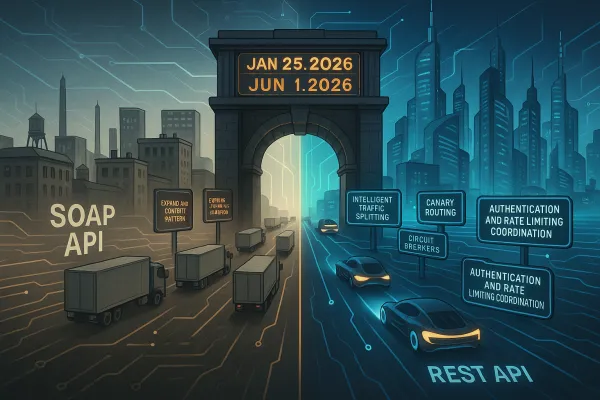
The real problem emerges when bundled contracts and shared authentication systems get separated during corporate restructures. What worked as a single FedEx API integration suddenly requires separate connections to FedEx Corporation for parcel services and independent FedEx Freight for LTL shipments. FedEx has begun disabling key Web Services WSDLs, including Tracking, Address Validation, and Validate Postal Codes, with SOAP-based Web Services now in development containment.
Breaking changes happen without proper warnings during these transitions. Carriers are now requiring six-digit Harmonized System (HS) codes on all international commercial shipments, effective September 1, 2025, with shipments without these codes potentially delayed or rejected. Your TMS integration might handle four-digit codes perfectly but fail silently when new validation rules activate.
Detection-First Architecture for API Breakage
Traditional monitoring fails during carrier transitions because it treats all APIs the same. While Datadog might catch your server metrics and New Relic monitors your application performance, neither understands why UPS suddenly started returning 500 errors for rate requests during peak shipping season.
Schema drift detection forms the first line of defense against breaking changes. Your monitoring needs to catch when FedEx Freight's rate response suddenly includes new required fields or when authentication endpoints change from OAuth to API key patterns. Here's what comprehensive API breakage detection requires:
Response structure validation - Monitor field additions, removals, and type changes in JSON responses. When FedEx adds mandatory shipment classification fields, you'll know before the first failed booking.
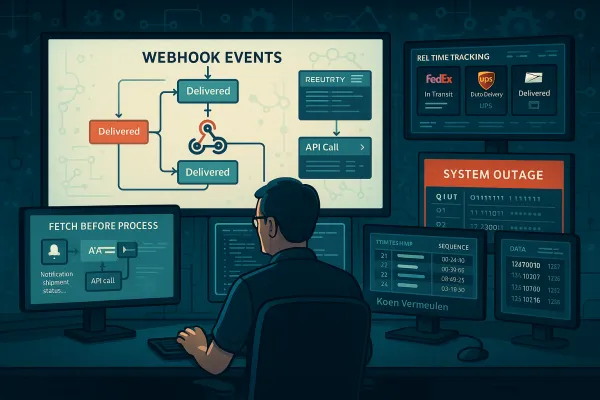
Authentication flow monitoring - Track token refresh patterns and detect when carriers change authentication requirements. Authentication-specific failures manifested as intermittent 401 responses during peak traffic periods, particularly affecting OAuth token refresh operations.
Behavioral pattern analysis - Establish baseline response times and error patterns for each carrier function. The Carrier Health Engine maintains baseline performance profiles for each carrier and can detect when UPS response times suddenly jump or when DHL starts returning malformed XML.
Version deprecation tracking - Parse API response headers for deprecation warnings. FedEx APIs use semantic versioning with major.minor format, where new major versions mean breaking changes and minor versions indicate backward-compatible changes.
Adaptive Integration Patterns for Multi-Carrier Environments
Enterprise TMS platforms need architectural patterns that survive major carrier transitions without manual intervention. The key lies in building normalization layers that abstract carrier-specific quirks while maintaining functionality during service disruptions.
Circuit breaker patterns work differently for carrier APIs than generic web services. When FedEx rate shopping fails, you can't simply return cached rates - shipping costs change constantly, and stale data creates billing discrepancies. Instead, implement cascading fallbacks that route rate requests to alternative carriers with similar service levels.
Multi-carrier routing requires intelligent load distribution that considers both technical performance and business requirements. During the FedEx Freight transition, your platform might need to split LTL requests between legacy FedEx endpoints and new independent Freight APIs based on shipment characteristics, not just technical availability.
Solutions like Cargoson, EasyPost, nShift, and ShipEngine each handle carrier transitions differently. Vendor-agnostic monitoring becomes crucial when managing platforms like EasyPost, nShift, and Cargoson simultaneously, with Cargoson providing real-time visibility into rate limit consumption across all carrier integrations, with predictive alerting when approaching limits.
Graceful Degradation During Service Transitions
When carrier APIs become unreliable during corporate transitions, your TMS platform needs degradation strategies that maintain business continuity without compromising data accuracy. This means more than simple error handling - you need business logic that makes intelligent decisions about incomplete or unreliable carrier responses.
Over 90% of organizations report downtime costs exceeding $300,000 per hour, making graceful degradation a financial necessity, not just good engineering practice. Your platform should support both old and new API versions simultaneously during transition periods, with automatic failover when primary carriers become unavailable.
SLA management during carrier transitions requires aligning technical metrics with business requirements. Generic uptime targets miss the nuance of carrier API performance - a 99.9% uptime metric means nothing if the 0.1% downtime coincides with your peak shipping hours. The monitoring needs to track these negotiated SLAs per carrier, not generic uptime metrics.
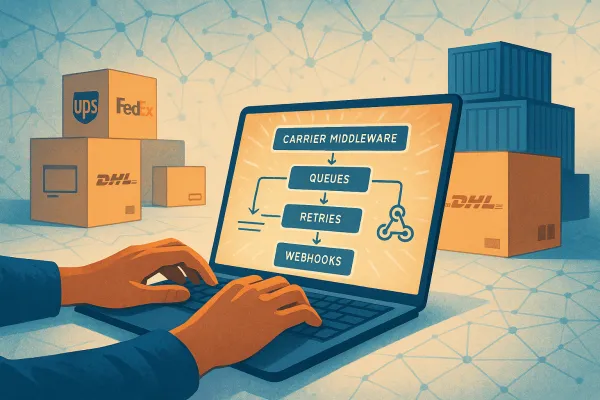
Platforms like MercuryGate, Descartes, Transporeon, and 3Gtms each implement different approaches to handling carrier service disruptions. The most resilient architectures combine multiple strategies: automated carrier selection based on real-time performance, intelligent retry logic that adapts to carrier-specific failure patterns, and business rule engines that can adjust shipping decisions when primary carriers become unreliable.
Implementation Roadmap for Resilient Carrier Integrations
Building carrier API breakage detection requires a staged approach that prioritizes high-impact monitoring before expanding to comprehensive coverage. Start with your highest-volume carriers and most business-critical functions - rate shopping and label creation typically generate the most immediate revenue impact when they fail.
Phase one focuses on basic schema monitoring and authentication tracking. Implement response structure validation for your top three carriers, monitor token refresh patterns, and establish baseline performance metrics. This foundation catches the most common breaking changes without overwhelming your operations team.
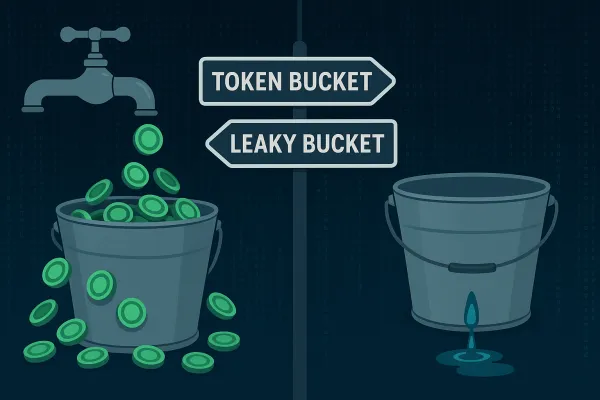
Phase two adds behavioral analysis and predictive alerting. Dynamic rate limiting improves API performance by up to 42% under unpredictable traffic, but that headline figure masks critical failure patterns emerging in multi-carrier environments. Build monitoring that understands carrier-specific failure modes and can predict problems before they impact shipments.
Budget considerations vary significantly based on your integration approach. Building custom monitoring for each carrier API costs substantially more than leveraging platform-provided monitoring. Most carrier integration platforms serve multiple shippers, requiring monitoring architecture that isolates performance data and alerting per tenant while efficiently sharing carrier connections.
The FedEx Freight spinoff represents a template for future carrier transitions. FedEx's $600 million IT infrastructure investment signals the scale of change coming to carrier APIs. TMS platforms that invest in proactive breakage detection and adaptive integration patterns today will maintain competitive advantages when the next major carrier restructure hits the industry.
Success requires treating carrier integration resilience as a business capability, not just a technical requirement. Your monitoring architecture should detect problems before they impact shipments, your integration patterns should adapt automatically to changing carrier requirements, and your degradation strategies should maintain business continuity when primary services become unreliable. The carriers will keep changing their APIs - your TMS platform needs to be ready.