Synthetic Monitoring for Carrier Integration: Detecting API Failures Before They Break Shipment Processing

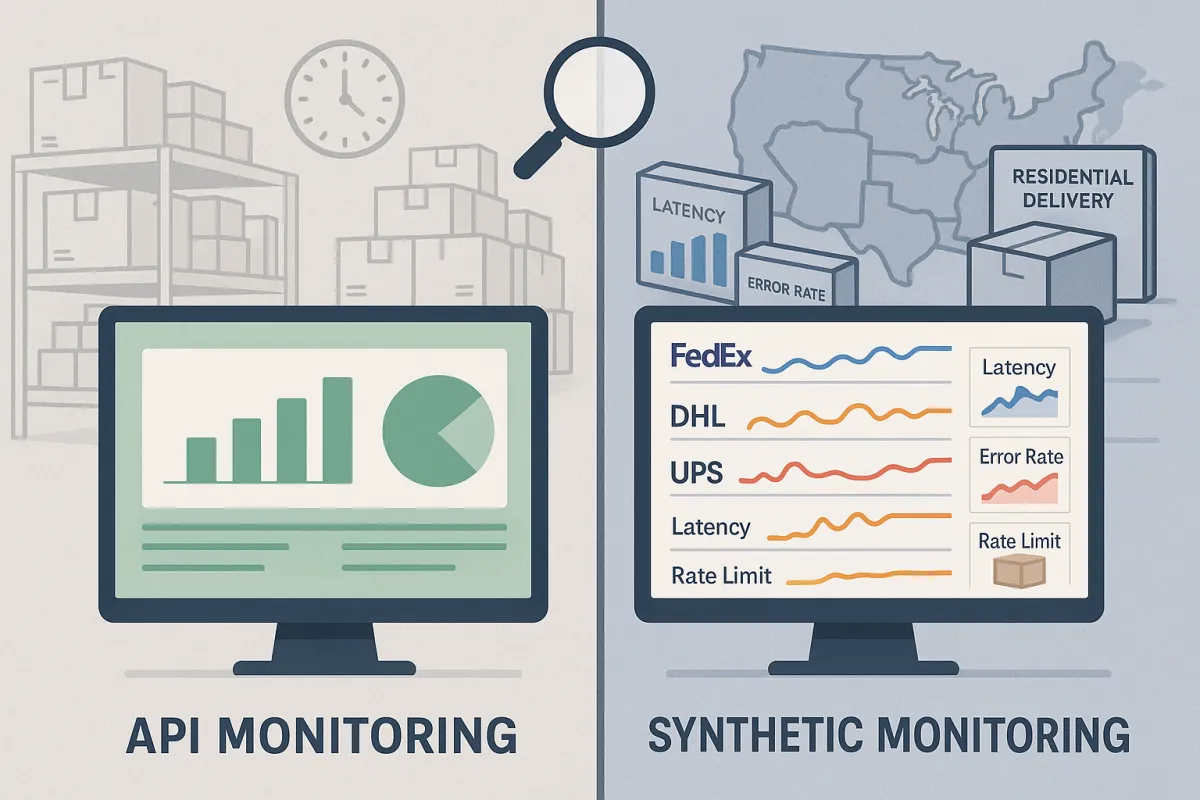
When average API uptime fell from 99.66% to 99.46% between Q1 2024 and Q1 2025, resulting in 60% more downtime, generic monitoring tools revealed their critical weakness: they treat all APIs equally. That number represents 350,000+ carrier integration teams discovering their monitoring systems weren't built for multi-carrier environments where FedEx, DHL, and UPS APIs all throttle simultaneously.
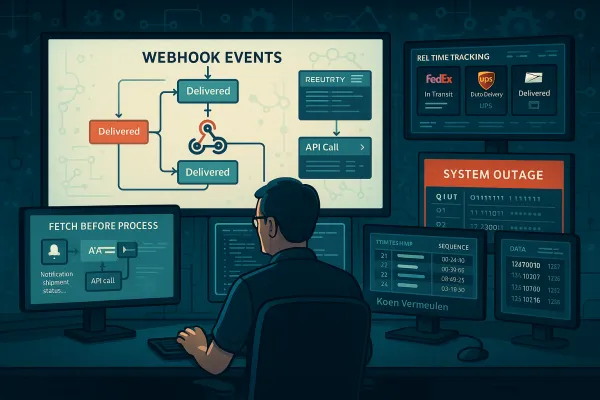
Your rate shopping response takes 2.8 seconds instead of 800ms. Your webhook delivery fails for 3% of tracking events. Your label generation returns HTTP 500 errors during peak morning shipping hours. Traditional monitoring catches these issues, but by then your shipment processing has already suffered cascading delays.
Logistics saw the sharpest decline in API uptime as providers expanded their digital ecosystems to meet rising demand for real-time tracking, inventory updates, and third-party platform integrations. This rapid growth increased reliance on external APIs across warehousing, transport, and delivery networks, creating failure patterns that standard monitoring never anticipated.
The Hidden Complexity of Carrier API Monitoring
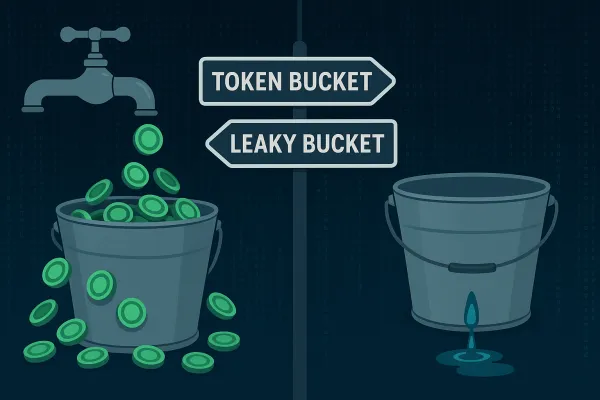
Carrier APIs fail differently than typical web services. Rate limiting has become more aggressive as carriers struggle to manage traffic during transitions. API Rate Limiting is critical for managing traffic, protecting resources, and ensuring stable performance. But your monitoring system treats rate limit responses (HTTP 429) the same as actual service failures.
During Black Friday 2024, one integration team watched their monitoring dashboard show "green" status while FedEx, DHL, and UPS APIs all throttle simultaneously during Black Friday volume. Their synthetic tests passed because they tested individual API calls, not the sustained load patterns that trigger carrier-specific throttling algorithms.
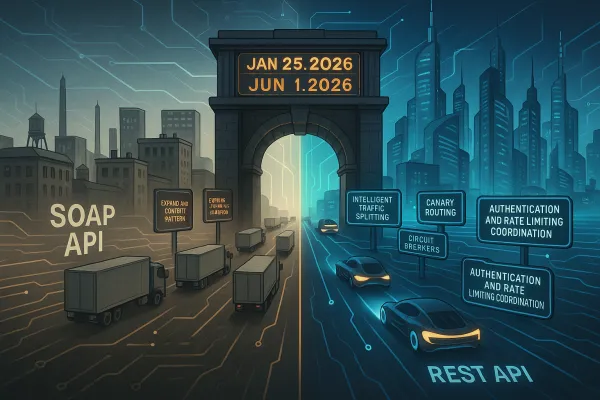
The difference matters because carrier failures create business logic problems that generic monitoring misses entirely. When UPS transitions to their new RESTful API architecture, any prior integrations, be it XML, SOAP, or legacy JSON payloads, will necessitate a complete transformation to align with UPS's RESTful APIs from their new API Catalog. Your monitoring needs to detect these breaking changes before they halt shipment processing.
Synthetic Testing Patterns That Actually Work for Multi-Carrier Environments
Synthetic monitoring is a proactive monitoring solution that enables you to create code-free API, browser, and mobile tests to automatically simulate user flows and requests to your applications. But effective carrier testing requires scenarios that reflect real shipping workflows, not generic API health checks.
Build synthetic tests around critical shipping operations: rate shopping across 3-5 carriers for identical shipments, label generation during peak volume windows, and tracking webhook delivery through your complete notification pipeline. Test geographic variations—companies like EasyPost, nShift, Cargoson, and ShipEngine build redundancy into their systems that individual carriers can't match when handling European postal requirements versus US domestic shipping rules.
Your synthetic tests should validate business logic, not just technical connectivity. When testing FedEx rate shopping, verify that residential delivery surcharges appear correctly, saturday delivery options reflect current service availability, and dimensional weight calculations match their published rules. A mid-size trading platform noticed a p95 latency increase in checkout flows via synthetic checks before customers reported issues. The monitoring system flagged rising 3xx/4xx errors from the payment provider and an uptick in retries. Engineers invoked the circuit breaker, routed transactions to a secondary gateway, preventing broader disruption.
Schedule carrier-specific test cadence. UPS APIs handle morning shipping volume differently than afternoon processing. DHL's European networks show different latency patterns during their maintenance windows. Test every 2-3 minutes during peak shipping hours (7-11 AM in your time zone), but extend intervals to 10-15 minutes during known low-traffic periods.
Multi-Tenant Monitoring Without Alert Noise
Multi-carrier platforms face unique challenges when multi-carrier platforms are stepping up as direct APIs struggle. Companies like EasyPost, nShift, Cargoson, and ShipEngine build redundancy into their systems. Each tenant might use different carrier combinations, negotiate different SLAs, and ship to different geographic regions.
Design tenant isolation that prevents cascade alerting. When DHL Express experiences authentication failures affecting European shipments, your monitoring should alert only tenants actively shipping to EU destinations through DHL, not every customer on your platform. Implement carrier-tenant filtering that correlates outages with actual business impact rather than theoretical exposure.
Circuit Breaker Architecture for Carrier Resilience
Circuit breakers protect your integration architecture when carrier APIs degrade. Circuit breakers are a valuable place for monitoring. Any change in breaker state should be logged and breakers should reveal details of their state for deeper monitoring. Breaker behavior is often a good source of warnings about deeper troubles in the environment.
Implement carrier-specific circuit breaker thresholds. When the consecutive number of errors from the backend (max_errors) is exceeded, the system changes to OPEN, and no further connections are sent to the backend. The system will stay in this state for N seconds ( where N = timeout). After the timeout, it changes to this state and allows one connection to pass (the test).
Configure different failure thresholds for different carrier operations. Rate shopping can tolerate higher error rates (maybe 15% failures over 5 minutes) because you can fall back to cached rates or alternative carriers. But label generation requires stricter thresholds (5% failures over 2 minutes) because shipping delays directly impact customer satisfaction.
Build intelligent failover logic that understands carrier strengths. If the service experiences failures beyond the defined threshold, the Circuit Breaker transitions to the open state, redirecting traffic to a fallback mechanism. During the open state, the API Gateway directs traffic to a fallback mechanism, which can be a cached response or a default behavior. After a predefined time, the Circuit Breaker transitions to the half-open state.
When FedEx Ground experiences delays, automatically route domestic shipments to UPS Ground while maintaining FedEx for international express services where their network provides better transit times. Your circuit breaker logic should preserve carrier relationships while protecting operational performance.
Schema Drift Detection for Breaking Changes
Carrier APIs evolve constantly. UPS is replacing its entire existing API infrastructure, while FedEx isn't just updating its API; it's championing a digital transformation. Both carriers had migration deadlines that got pushed back multiple times as companies struggled to adapt.
Monitor API responses for unexpected schema changes that signal upcoming breaking changes. Track field additions, removals, and type changes across carrier responses. When FedEx adds a new required field to their tracking webhook payload, your monitoring should detect this change before it breaks your parsing logic.
Parse deprecation headers and warning messages from carrier API responses. Most carriers signal upcoming changes through HTTP headers like Sunset or Warning before implementing breaking changes. Build automated workflows that create engineering tickets when your monitoring detects deprecation signals, giving your team weeks or months to plan migrations instead of discovering changes during outages.
Implement version compatibility testing across carrier API migrations. When UPS announces OAuth 2.0 migration timelines, your synthetic tests should validate both old and new authentication flows until cutover dates. Developers have until May 15, 2024 to adopt the improved FedEx API, at which point previous SOAP APIs will become completely inaccessible. For UPS, any prior integrations, be it XML, SOAP, or legacy JSON payloads, will necessitate a complete transformation.
Production-Ready Implementation Patterns
Effective synthetic monitoring requires tests running every 2-5 minutes against production services, with results feeding into monitoring systems and displaying on team dashboards. Gain deep visibility into your internet stack—including CDNs, SaaS APIs, cloud providers, and networks—to pinpoint issues and eliminate unnecessary troubleshooting cycles.
Avoid synthetic traffic pollution in carrier analytics. Use dedicated test credentials when carriers provide sandbox environments that mirror production behavior. For carriers requiring production API keys, implement clearly-marked test shipments using non-existent ZIP codes or carrier-specific test addresses that don't create actual shipping labels.
Build monitoring that understands carrier business hours and maintenance windows. If DHL Express API failures spike on Mondays, investigate their system maintenance schedules. We tracked this pattern and found that predictable maintenance windows create cascading failures when adaptive algorithms don't account for carrier-specific downtime patterns.
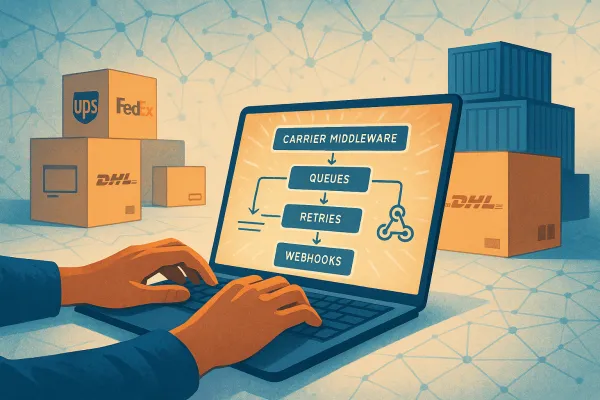
Integration monitoring should connect with existing TMS platforms and observability stacks. For integration platforms, solutions like Cargoson build monitoring into their carrier abstraction layer. This means you get carrier-specific health metrics without building custom monitoring for each API. Compare this against managing individual monitoring across multiple platforms.
Alert Management That Prevents Notification Fatigue
Organizations implementing resiliency engineering practices with APIs experience 50% less downtime, but only when alerting focuses on actionable signals rather than noise. Design SLAs that reflect actual business requirements: 2-second response times for rate quotes matter more than 500ms tracking updates because customers wait for shipping options but don't actively watch tracking pages.
Implement intelligent alerting during carrier-wide outages. When AWS infrastructure issues affect platforms like ShipEngine and ShipStation, multi-carrier platforms that rely on AWS for computing, networking, or database services found their response times degrading even when their primary carrier APIs remained functional, your alerts should correlate infrastructure problems with carrier performance rather than flooding teams with individual service warnings.
Organizations implementing strategic API usage patterns see 30-40% reduction in monitoring costs while improving data quality when they focus monitoring on business-critical operations rather than comprehensive API coverage. Monitor carrier operations that directly impact revenue: label generation, rate shopping, and shipment confirmation. Track rather than alert on less critical operations like address validation and service availability checks.
Your carrier integration monitoring strategy determines whether API failures become customer-visible outages or transparent failovers. Build synthetic monitoring that tests real shipping workflows, implement circuit breakers tuned for carrier-specific failure patterns, and create alerting focused on business impact rather than technical metrics. Focus on business logic validation, implement carrier-aware alerting, and build automation that understands shipping domain failures. Your customers will notice the difference.