
AsyncAPI 3.0 for Carrier Integration: Production Patterns That Solve Discovery and Ordering Challenges When REST APIs Aren't Enough

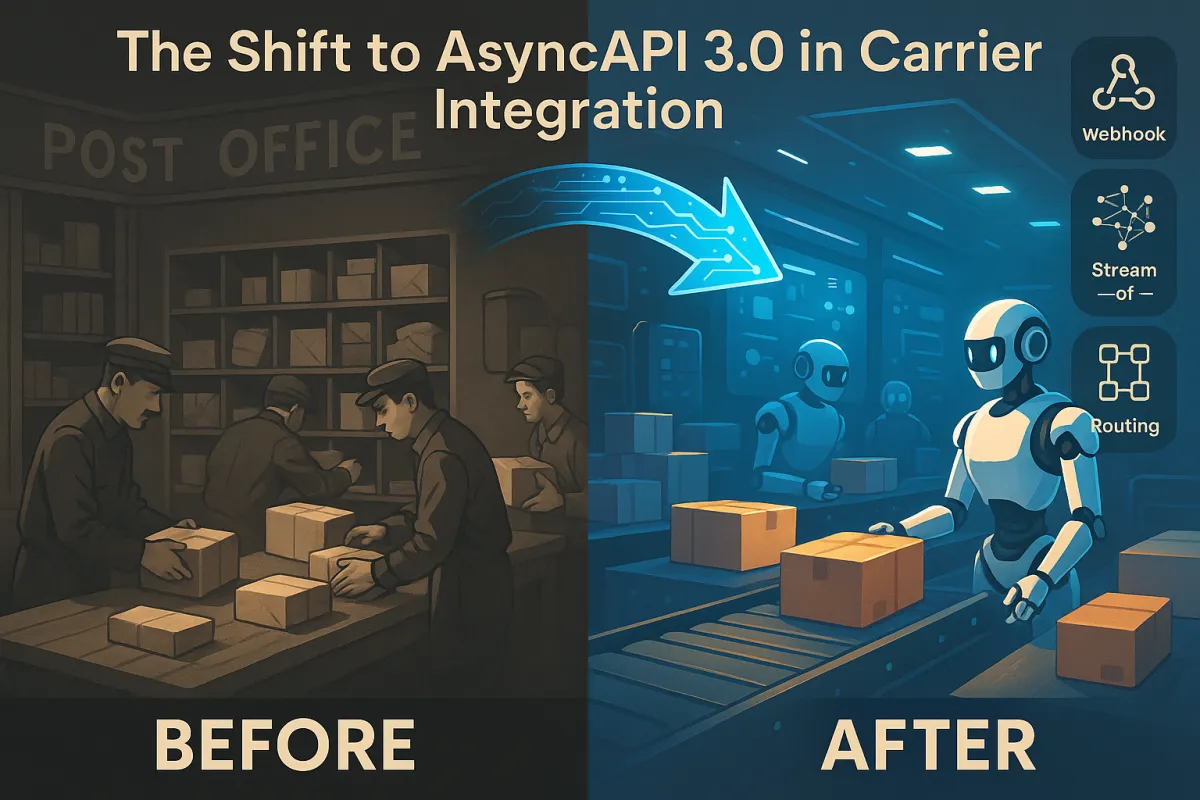
In 2026, major carriers including UPS, USPS, and FedEx will complete a shift that's been years in the making: retiring legacy carrier APIs in favor of more modern, secure platforms. For carrier integration middleware teams, this shift coincides with the 3.0 release in late 2023 cleaned up enough rough edges that 2026 is the year teams running event-driven systems finally start adopting it in production of AsyncAPI. The timing isn't coincidental. Modern carrier APIs now push webhooks for status updates, rate changes, and service disruptions rather than expecting constant polling. By 2026, event-driven adoption has reached the point where the spec has real momentum: 86% of IT leaders cite data streaming as a top strategic priority.
The challenge for platform engineers isn't just adopting AsyncAPI 3.0 for documentation. The current stable version is AsyncAPI 3.0, released November 2023, which split operations out of channels and made the spec significantly less ambiguous than 2.x. The real question becomes: how do you design carrier integration platforms that handle both the synchronous operations (rate shopping, label generation) and the async flows (status webhooks, capacity updates) without creating architectural chaos?
The Carrier Integration Async Use Cases That Drive AsyncAPI 3.0 Adoption
Carrier APIs have traditionally been request-response. You call an endpoint for rates, get back JSON with prices, then call another endpoint to create a label. Simple enough. But As carriers introduce more dynamic rates based on demand and capacity, merchants can choose the right carrier for each shipment as conditions change, and Merchants will be able to offer delivery dates based on current transit conditions and capacity, as delivery APIs become more dynamic.
Modern carrier APIs generate events that middleware platforms need to consume:
- Status progression updates: Package scanned, out for delivery, delivered, exception events. With real-time feeds, supply chain teams can be immediately notified in NetSuite of exceptions like delivery exceptions, delays, address issues, or lost packages. This allows proactive outreach.
- Rate fluctuations: Peak season surcharges, fuel adjustments, capacity-based pricing that changes hourly during high-demand periods.
- Service disruptions: Weather delays, facility closures, route changes that affect transit times and delivery commitments.
- Capacity notifications: Available pickup slots, cutoff time changes, service level availability in specific lanes.
FedEx Advanced Integrated Visibility delivers near real-time tracking updates straight to your servers using webhook technology. Get instant, automated push notifications that keep you and your recipients informed every step of the way. UPS and USPS have similar offerings. But here's where AsyncAPI 3.0 becomes valuable: these aren't just webhooks—they're complex event streams that need proper contracts, ordering guarantees, and multi-tenant routing patterns.
Traditional middleware vendors like Cargoson, nShift, and EasyPost are all grappling with the same architectural question: how do you handle thousands of webhooks per minute from multiple carriers while maintaining tenant isolation and ordering semantics?
Discovery and Governance: The Scale Problem AsyncAPI Solves
At scale, ad-hoc event handling breaks down. Allowing API producers to reuse definitions sourced from, for example, an enterprise-wide API repository provides critical information for purposes of API governance. Moreover, API providers can readily understand the impacts of change when they amend their API description documents written in AsyncAPI.
The pain hits when you're operating carrier integration platforms serving hundreds of clients. Without machine-readable contracts, you get scenarios like:
- FedEx adds a new event type in their webhook payload schema, but only some consumers know about it
- UPS changes the timestamp format in status events (happened during their OAuth migration), breaking downstream parsing
- Carriers deprecate webhook event types, but platform teams discover this through failed deliveries, not proactive communication
AsyncAPI 3.0 specifications create machine-readable event contracts. Here's a simplified example for carrier status updates:
asyncapi: 3.0.0
info:
  title: Carrier Status Events
  version: 1.2.0
channels:
  carrierStatusUpdates:
    address: "events/carrier/status"
    messages:
      StatusUpdate:
        payload:
          type: object
          properties:
            tracking_number:
              type: string
            carrier_code:
              type: string
              enum: [fedex, ups, usps]
            status_code:
              type: string
            occurred_at:
              type: string
              format: date-time
operations:
  receiveStatusUpdate:
    action: receive
    channel:
      $ref: "#/channels/carrierStatusUpdates"
This approach scales because consumers can generate client code, validate payloads automatically, and detect breaking changes before they hit production. With buy-in from tooling makers and vendors, it could become the spine of API governance in the enterprise messaging ecosystem.
Event Ordering and State Consistency Patterns
carrier_occurred_at is the timestamp of the event received from the carrier, it is assumed to be the local time of where the event occurred. Note that this property is not yet fully supported across all carriers. occurred_at is the UTC based time of the event's occurrence. This timestamp complexity is exactly why event ordering becomes critical in carrier integration.
Webhooks don't arrive in chronological order. A "delivered" event might reach your system before the "out for delivery" event, especially during peak traffic periods. Carrier integration platforms need ordering strategies that work with partial information:
- Timestamp-based ordering: Use the carrier's event timestamp, not your receipt timestamp, but handle timezone inconsistencies and missing timestamps gracefully
- Logical ordering: Status codes have implicit sequencing (in-transit → out-for-delivery → delivered). Build state machines that can handle out-of-order events
- Tenant-scoped ordering: For multi-tenant platforms, you usually only need ordering within a tracking number or customer context, not global ordering
AsyncAPI 3.0's explicit operation definitions help document these ordering expectations. When you specify that your application will "receive" status events on a channel, you can include message examples showing expected sequences and document how your system handles reordering.
Multi-Protocol Architecture: When to Use What
Not everything should be async. Rate shopping still needs synchronous responses—you can't show shipping options to a customer after they've already clicked "buy". OpenAPI does a great job of describing one thing: a synchronous HTTP request. The client sends a method and a path, the server returns a status and a body, and the contract is complete. Async does not fit that shape.
The pattern that emerges in production carrier integration platforms: RESTful HTTP at system boundaries, async messaging internally. An API gateway handles rate requests synchronously but publishes "rate_requested" events to internal services for analytics, fraud detection, and capacity planning.
Event brokers absorb the impedance mismatch between high-throughput carrier APIs and slower consumers. When FedEx sends 10,000 tracking updates during a peak hour, your event broker queues them for processing at whatever rate your downstream systems can handle.
Protocol bindings in AsyncAPI 3.0 make this explicit. The same event contract can bind to HTTP webhooks (for external carrier integrations), Kafka topics (for internal high-throughput processing), and AMQP queues (for reliable delivery to tenant-specific consumers). Platforms like Shippo, Cargoson, and EasyPost are building architectures that support multiple protocols behind a unified event interface.
Schema Evolution and Version Management
In v2, the publish and subscribe operations consistently caused confusion, even among those familiar with the intricacies... In v3, these operations have been entirely replaced with an action property that clearly indicates what your application does. This clarity helps when evolving carrier event schemas over time.
Carrier APIs evolve constantly. Carriers have been migrating their API infrastructure for several years. UPS was the first to phase out its legacy APIs in 2025. In 2026, USPS and FedEx are following suit. Schema evolution becomes critical when you're supporting multiple carrier API versions simultaneously during migration windows.
AsyncAPI 3.0's message versioning supports both breaking and non-breaking changes:
- Additive changes: New optional fields in webhook payloads can be added without breaking existing consumers
- Format changes: Timestamp formats, enum values, or field names that break parsing logic require new message versions
- Compatibility windows: Document how long old message versions will be supported during carrier API transitions
Code generation from AsyncAPI specs creates generic connector interfaces that abstract transport knowledge from business logic. Your webhook processors work with strongly-typed event objects, regardless of whether the underlying transport is HTTP, Kafka, or AMQP.
Implementation Patterns and Operational Considerations
Event-driven architectures trade simplicity for scalability. Adoption inside organizations is uneven. REST teams might already have OpenAPI conventions, but the messaging team is often documenting in Confluence. Rolling out AsyncAPI is half technical, half cultural.
The operational challenges hit harder in carrier integration because of the reliability expectations. When a tracking update fails, customers notice. When rate shopping goes down during peak hours, revenue drops immediately.
Testing becomes more complex in event-driven systems. With synchronous APIs, you send a request and validate the response. With event flows, you need to test:
- Event delivery under failure conditions (webhook endpoints down, network partitions)
- Ordering behavior when events arrive out of sequence
- Rate limiting and backpressure when carriers send burst traffic
- Multi-tenant isolation when processing events for thousands of customers
Carrier supports the HTTP 429 Too Many Requests response code along with the Retry-After header to set visibility timeouts on messages. Carrier also sends the X-Carrier-Receive-Count and X-Carrier-First-Receive-Time headers with each POST to the webhook. These headers allow the webhook logic to understand how many times the message has been received and when it was first received. This kind of retry metadata becomes essential for debugging production issues.
Observability challenges multiply with async patterns. you have no way to understand who is doing that becomes a real problem when tracking down why certain webhook deliveries are failing. You need distributed tracing that follows events across protocol boundaries, from carrier webhook to internal queue to tenant-specific delivery.
Circuit breaker patterns for async flows differ from synchronous patterns. Instead of failing fast on API calls, you need to handle scenarios like:
- Carrier webhook endpoints experiencing high latency but still accepting connections
- Internal event queues backing up during traffic spikes
- Tenant-specific consumers falling behind on event processing
Platforms like FreightPOP, Descartes, and MercuryGate that handle enterprise volumes need SLOs that account for end-to-end event delivery latency, not just webhook receipt acknowledgment.
When NOT to Use AsyncAPI Patterns
Avoid async patterns when the interaction genuinely requires immediate responses. Rate shopping during checkout can't wait for eventual delivery of pricing events. Address validation needs to block form submission until results arrive.
Single consumer scenarios often don't justify the complexity. If only one system needs carrier tracking updates, direct webhook integration might be simpler than publishing events to a broker that only has one subscriber.
If you can live with those caveats, the upside of having a single contract for your async surface is large. But for teams just getting started with carrier integration, or those supporting only a few low-volume carriers, the tooling and operational overhead may outweigh the benefits.
Team experience matters. OpenAPI has thousands of integrations; AsyncAPI has dozens. If your IDE has an OpenAPI plugin, the AsyncAPI plugin (if it exists) is usually less polished. Mock servers are weaker. Factor this into your timeline when evaluating AsyncAPI adoption.
The decision point usually comes down to scale and complexity. If you're building multi-tenant carrier middleware that needs to support hundreds of shippers with different SLA requirements, AsyncAPI 3.0 provides the governance and tooling scaffolding that ad-hoc event handling can't match. If you're building a single-tenant system with predictable traffic patterns, the additional complexity might not be justified.