
API Gateway Evolution for Multi-Tenant Carrier Integration: Designing Request Routing That Scales from REST APIs to AI-Driven Shipping Workflows

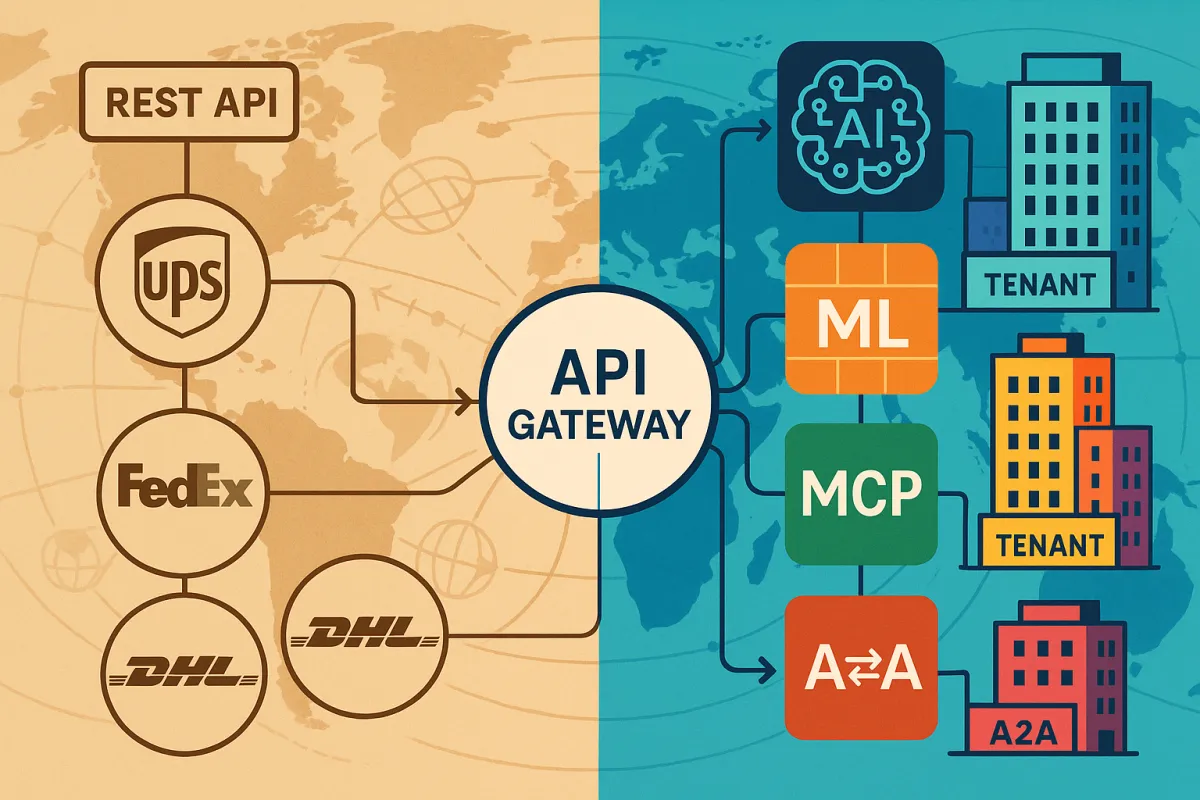
Multi-tenant API gateways serving carrier integration platforms face pressures that traditional gateway architectures weren't designed to handle. Multi-tenancy is one of those architectural challenges that looks simple on paper — "just add a tenant ID to the request" — but quickly explodes into complexity when you need real isolation, routing, and observability at scale. When your gateway sits between thousands of tenants and dozens of carrier APIs, each with unique rate limits, authentication methods, and webhook patterns, the routing decisions become exponentially more complex.
An ideal retry rate should be less than 5% for most webhook systems, but carrier integration platforms routinely see retry rates above 20%. This creates an architecture challenge that extends beyond basic traffic management. Your gateway isn't just proxying requests—it's managing stateful relationships between tenants and carriers, handling burst traffic during shipping peaks, and coordinating webhook fanout across multi-tenant environments where one tenant's DHL outage shouldn't affect another's UPS integrations.
The 2026 Gateway Evolution: From Traffic Proxies to AI-Native Infrastructure
In 2026, they manage autonomous agents. Here's what changed and why it matters. The architectural shift happening in 2026 goes beyond adding AI endpoints to existing gateways. To support this shift, developers are adopting protocols like Model Context Protocol (MCP) and Agent2Agent (A2A) to standardize how components exchange tools, data, and decisions.
In 2026, a single workflow might use Claude Opus for deep reasoning, Haiku for fast triage, a fine-tuned open-source model for domain-specific tasks, and a local model for sensitive data that can't leave your network. When you're building shipping middleware, this means your gateway needs to route between traditional REST APIs for carrier rate requests and AI agents making autonomous shipping decisions, all while maintaining tenant isolation and cost controls.
The Model Context Protocol introduces session-aware routing requirements that traditional API gateways struggle with. Unlike stateless API routing, MCP traffic requires session affinity: Sticky sessions — all requests within an MCP session are routed to the same backend server instance · Session discovery — the gateway maintains a session registry mapping session IDs to backend instances · Graceful session migration — when a backend needs to drain, the gateway can migrate active sessions
Multi-Tenant Routing Patterns for Carrier Integration
Tenant identification in carrier integration creates unique challenges compared to typical SaaS routing. To enforce usage plans for each tenant separately, use tenant ID as a prefix to a uniquely generated value to prepare the custom API key. But carrier APIs complicate this pattern because many don't support custom headers, and others have specific authentication requirements that conflict with standard tenant identification approaches.
Consider the practical routing challenges when Tenant A uses UPS through OAuth tokens while Tenant B connects to the same UPS API through their own credentials, and Tenant C needs both UPS and FedEx with different rate limits per carrier. For example, two separate tenants may desire to have an API route path matching /users. This won't work with a shared data plane — the gateway does not know which upstream service should receive the traffic to /users.
Geographic routing adds another layer of complexity. European carrier integration platforms like Cargoson, nShift, and others must handle data locality requirements where German shipments to Poland must route through EU data centres, while US shipments can't touch European infrastructure due to carrier contract restrictions. Consider geographical distribution of retry processing. If most carrier APIs are hosted in European data centres, running retry workers in the same regions reduces latency and improves success rates. The infrastructure cost increase often pays for itself through reduced retry attempts.
Failure Domain Isolation for Carrier APIs
Ocean carriers like Maersk and MSC provide APIs with network issues or consumer service downtimes that persist for hours. LTL carriers frequently return 5xx errors during peak shipping periods when their systems buckle under volume. Last-mile delivery APIs from FedEx and UPS experience maintenance windows that can span entire nights, leaving webhook deliveries queued and aging.
Your gateway needs circuit breaker coordination that prevents one tenant's Maersk integration from affecting others when MSC APIs are healthy. We documented specific cascade patterns: FedEx rate limits trigger failover to UPS, which then hits its limits and fails over to DHL, creating a "carrier domino effect" that exhausts all available options within 90 seconds. When FedEx, DHL, and UPS APIs all throttle simultaneously during Black Friday volume, those theoretical improvements disappear fast. Your monitoring needs to detect these cascade scenarios before they exhaust all carrier options.
Webhook Fanout Architecture That Scales
Multi-tenant webhook delivery in carrier integration faces unique timing and reliability challenges. Queue architecture decisions significantly impact costs. AWS SQS with dead letter queues might cost $50/month for a single-tenant system but $5,000/month for a multi-tenant platform handling millions of carrier webhooks. Apache Kafka requires more operational overhead but provides better cost scaling for high-volume scenarios.
Session affinity becomes complex when dealing with ocean freight tracking that spans weeks versus parcel delivery events that complete in hours. Your gateway needs to maintain tenant-specific webhook subscriptions while coordinating delivery failures across different carriers with varying retry policies.
Dead letter queue patterns require carrier-specific intelligence. Cost optimisation starts with accepting that not all webhooks deserve equal retry investment. A customs clearance notification for a $50,000 electronics shipment justifies aggressive retry attempts across multiple hours. A delivery exception for a $15 document envelope might not warrant the same resources. Implement webhook priority tiers based on shipment value, customer SLA requirements, and message criticality. High-priority webhooks get immediate retries and premium queue processing. Low-priority webhooks use longer retry intervals and cheaper storage options.
Our testing showed 8-12% duplicate delivery rates during peak periods across all platforms. When you're managing webhook fanout for platforms like nShift, EasyPost, or Cargoson, idempotency key coordination becomes critical across tenant boundaries to prevent duplicate processing while maintaining delivery guarantees.
AI-Native Features for Autonomous Shipping Agents
Your agents now talk to Slack, Notion, databases, browsers, and internal APIs through MCP servers. An AI gateway sitting at this boundary is the natural enforcement point for access control, rate limiting, and audit logging—the same role API gateways have played for REST traffic for over a decade.
Token-aware rate limiting becomes crucial when AI agents call shipping APIs for decision-making. Rather than treating MCP as an isolated capability, Bifrost integrates it as a native feature of a high-performance AI gateway built in Go. This design delivers significant advantages for production AI agents. ... Sub-ms latency performance - Adds only 11µs overhead while handling 5,000+ requests per second, delivering 50x faster performance than alternatives like LiteLLM
Semantic routing enables intent-based routing for AI-driven shipping workflows versus traditional CRUD operations. When an agent needs to find the cheapest freight option from Amsterdam to Prague, the gateway can route to specialized rate shopping services while maintaining the same request interface for label generation or tracking updates.
The security implications extend beyond traditional API authentication. OIDC and OAuth 2.1 for Agent Identity. The days of hardcoding SECRET_KEY in a .env file are functionally over for any serious production deployment. Modern MCP gateways use OpenID Connect (OIDC) to establish verifiable relationships between an AI instance and the tools it can access. Rather than granting permissions to "Claude" as a category, you grant them to agent-uuid-4412 — a specific instance with a defined scope, a human sponsor, and an expiry.
Implementation Strategy for Gateway Migration
Blue-green deployment for gateway upgrades requires careful coordination when managing carrier API connectivity. Parallel Run Strategy: Never switch entirely at once. Build adapter layers that can route requests to either legacy or modern APIs based on configuration flags. This lets you test production traffic loads against new endpoints while maintaining fallback capability.
Cost optimization through ARM-based compute shows significant improvements for stateless gateway tasks. The serverless scaling patterns that work for typical API traffic need adjustment when handling carrier webhook bursts during peak shipping seasons like Black Friday or Chinese New Year.
Multi-tenant JWT validation requires carrier-specific considerations. Enterprise shippers using platforms like nShift, EasyPost, or Cargoson often discover this during their first major volume spike. The same shipment gets processed multiple times because each retry appears as a distinct request from the carrier's perspective. Your gateway needs idempotency key enforcement that works across tenant boundaries while preventing unauthorized cross-tenant access.
Production Lessons from Real-World Implementations
Capacity planning for carrier integration gateways differs from typical web traffic patterns. USPS's new APIs enforce strict rate limits of approximately 60 requests per hour, down from roughly 6,000 requests per minute without throttling in the legacy system. When multiple tenants share the same carrier endpoint through your gateway, rate limit coordination becomes a distributed systems problem.
Performance benchmarks from production systems reveal the hidden costs of multi-tenant carrier integration. While average response times stayed within acceptable ranges, P95 latencies spiked to 3.2 seconds during carrier rate limit events. If 95 percent of your calls complete in 100ms but 5 percent take 2s, that will frustrate users and break dashboards.
Monitor the true cost of webhook retries across your platform. Include compute time, storage costs, carrier API consumption charges, and operational overhead. Platforms like Cargoson and others in the carrier middleware space often see retry-related costs consume 20-40% of their infrastructure budget—a reality that traditional API gateway cost models don't account for.
Incident patterns reveal common failure modes that span multiple tenants. When UPS OAuth services experience load spikes, authentication failures cascade across all tenants using UPS through your gateway. Authentication failure root cause analysis requires carrier-specific knowledge. UPS authentication errors during peak seasons often indicate DynamoDB scaling issues. FedEx OAuth problems typically stem from rate limiting in their authorization services. Your incident response procedures should include carrier-specific debugging steps. Escalation paths differ by carrier and failure type. UPS developer support responds fastest to authentication issues during business hours Pacific time. FedEx provides 24/7 support for OAuth problems affecting high-volume accounts.
Integration with established middleware platforms requires careful architectural decisions. When evaluating solutions alongside Cargoson, nShift, EasyPost, or ShipEngine, consider how your gateway handles the abstraction layers these platforms provide versus direct carrier connections. Cargoson, along with competitors like MercuryGate and BluJay, built abstraction layers that handle the OAuth complexity, implement intelligent rate limiting queues, and provide fallback mechanisms when USPS quotas are exceeded. Our benchmark harness measured eight platforms over three months: EasyPost, nShift, ShipEngine, LetMeShip, and Cargoson, plus direct integrations with DHL Express, FedEx Ground, and UPS. The testing revealed a fundamental gap between single-carrier optimization and multi-carrier reality. EasyPost handles burst traffic well but struggles with sustained high volume. nShift provides excellent visibility but can be slow to adapt. ShipEngine offers good balance but limited carrier coverage.
The architectural patterns that succeed in 2026's carrier integration landscape combine traditional multi-tenant routing with AI-native features, carrier-specific intelligence, and webhook delivery guarantees that can withstand the operational realities of shipping APIs. Your gateway design decisions today determine whether your platform scales with the autonomous shipping agents of tomorrow or becomes a bottleneck in increasingly automated logistics workflows.